
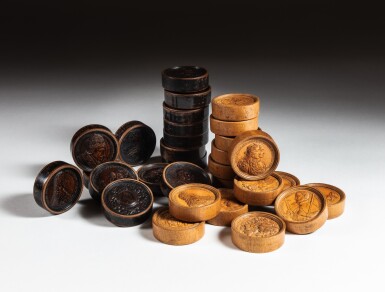
A set of thirty backgammon counters in maple and stained wood, Nuremberg, Germany, late 17th–early 18th century, some with the monogram of Martin Brunner
No reserve
Estimate
4,000 - 6,000 EUR
We may charge or debit your saved payment method subject to the terms set out in our Conditions of Business for Buyers.
Read more.Lot Details
Description
comprising 15 maple counters and 15 stained wood counters
(30)
Diam. 56 mm ; diam. 2 3/16 in.
The game of backgammon is mentioned by Niccolò Machiavelli in 1513 and became very popular during the 17th and 18th centuries in Europe, particularly in France and Germany.
The technique for creating these wooden game pieces is similar to that of medals, and they were often produced by medal engravers such as Martin Brunner. The turned wood was first softened with steam, and then the scenes were pressed using metal dies. Martin Brunner (1659–1725) was a medal and seal engraver in Nuremberg and a maker of wooden game pieces. A very similar game is held in the collections of the Cleveland Museum of Art (1953.691).
You May Also Like


