
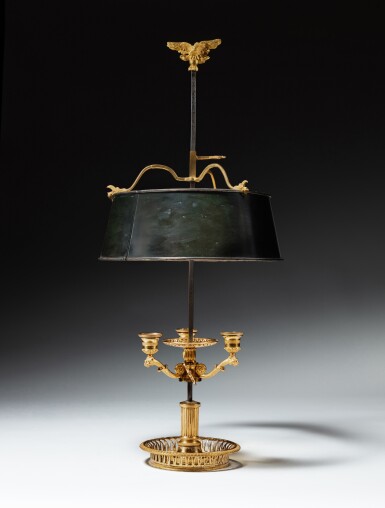
An Empire gilt-bronze bouillotte lamp, circa 1810
No reserve
Estimate
2,000 - 3,000 EUR
Lot Details
Description
with three lights each terminating with a lion’s head, surmounted by an eagle, the fluted shaft resting on a circular base, fitted with a black lacquered metal tole shade
Height 29 1/2 in., diam. 13 in.
Related literature
O. Nouvel-Kammerer, L’Aigle et le papillon : symbole des pouvoirs sous Napoléon (1800-1815), Paris, 2007, MAD, 2 avril – 5 octobre 2008, p. 52
M.-F. Dupuy-Baylet, L’heure, le feu, la lumière : Les bronzes du mobilier national (1800-1870), Dijon, 2010, p. 58, p. 59
M.-F. Dupuy-Baylet, De bronze et de cristal : Objets d’ameublement XVIIIe-XIXe siècles du Mobilier National, Dijon, 2020, p. 313, p. 316, p . 378, p. 379
The “Flambeau-Bouillotte”
The flambeau-bouillotte, as it appears in 19th-century furniture inventories, emerged at the end of the reign of Louis XVI. It takes its name from the card game bouillotte and was designed to illuminate the players gathered around the table, thanks to a sliding mechanism that allows the intensity of the light to be adjusted.
The bouillotte lamp remained in use during the Empire period, when it also came to be regarded as a working tool. Napoleon is thus depicted by Jacques-Louis David in his study in 1812, with a bouillotte lamp placed on his desk (National Gallery of Art, Washington, inv. 1961.9.15).
The Lion in Imperial Symbolism
The lion heads adorning the light branches of our lamp testify to the central role of this animal in the decorative vocabulary of the Empire style. On the eve of the proclamation of the Empire, and again at its official establishment on 18 May 1804, the need for a new symbolic language became apparent. Napoleon initially expressed a preference for the lion, which he imagined “stretched out over the map of France, its paw ready to cross the Rhine.” Although first drawn to the image of the reclining lion, he was ultimately persuaded by Vivant Denon to adopt the eagle as his personal emblem.
These lion heads find close parallels in gilt-bronze production under the Empire, notably on two pairs of wall lights: one made by Thomire, Duterme et Compagnie for the dining room of Apartment no. 2 in the Palace of Fontainebleau (inv. GML 2128/1 and 2), and the other executed around 1809 by Antoine-André Ravrio for the officers’ salon at the Palace of Rambouillet (inv. GML 5892/1 and 2).