
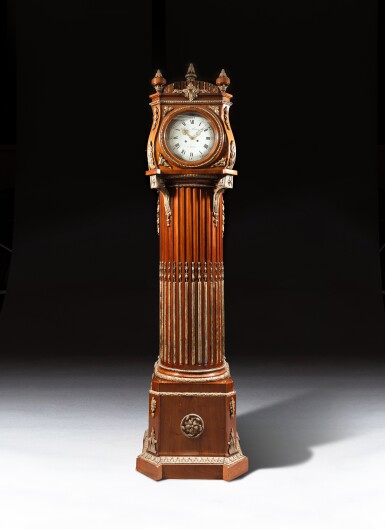
A silvered-wood mounted mahogany longcase organ clock, Christian Ernst Kleemeyer, Berlin, circa 1790
Estimate
10,000 - 15,000 EUR
Lot Details
Description
the enamel dial with strike/silent lever at XII and signed C E Kleemeyer, In Berlin, finely pierced gilt hands, the two train weight-driven clock movement with anchor escapement and hour striking on a bell, the organ with massive weight-driven motor and driving a pinned wooden cylinder playing the William Tell Overture on twenty seven wooden pipes, triggered by the clock movement at the hour, the neo-classical case with bombé-shaped hood and turned finials above lattice fret side doors, the stop-fluted columnar trunk on a stepped plinth with canted corners, the whole applied with silvered foliate mounts
Haut. 273 cm, larg. 73 cm, prof. 58 cm ; Height. 107 ½ in, width
Although the origin of the flute clock (flötenhur) is unknown, it appeared around 1600 and reached its peak at the end of the 18th century, being manufactured in Germany, particularly in the Black Forest between 1770 and 1850. These clocks allow you to listen to music at the hour rather than the usual chime. The mechanism could be a miniature organ or, as in our regulator, a set of wooden flutes with plugs called drones.
Several great composers wrote works for these clocks, including Georg Friedrich Handel, Joseph Haydn, Wolfgang Amadeus Mozart and Ludwig van Beethoven.
Our regulator plays Rossini's Overture to William Tell, composed in 1829. As the cylinder used to play the piece is interchangeable, our regulator originally played a different piece.
C.E Kleemeyer (1766-1812) was a German clockmaker who became a master craftsman in Berlin in 1790. He worked in particular at the court of Frederick II of Prussia, for whom he delivered a regulator clock for Sanssouci Palace in 1812. In his Berlin workshop, he offered a wide range of cases that could be assembled according to the customer's requirements. He made clocks in the neoclassical style, such as a flötenhur clock, circa 1785, in the shape of a column on a large square base, now in the Kunstgewerbmuseum in Berlin (inv. 1904,130). This column is based on the same model as our regulator. Another example is a flötenhur clock with the same column decoration, kept at Siegfrieds Mechanisches musikkabinett in Rüdesheim am Rhein, circa 1780. Another 260 cm high flötenhur clock in white painted wood with the same column was sold at Kunstauktionhaus Günther in Dresden on 14 November 2020, lot 149.
Kleemeyer was one of the most important clockmakers of the period, alongside Louis George and Christian Möllinger. He produced impressive and varied pieces, such as a flötenhur secrétaire delivered to the King of Denmark and Norway, presented in a German gallery, a flötenhur clock in mahogany in the shape of a neoclassical urn kept at the Museum für Musikinstrument der Universität in Leipzig (inv. 2050) and a flötenhur clock from around 1800, with a square base topped by a 275 cm high statue of Apollo, kept at Siegfried's Mechanical Music Cabinet in Rüdesheim am Rhein (inv. 4901).