13 Artworks You Can't Miss from The London Sales
Our specialists choose some of their favorite works from the upcoming sales in London including pieces from David Hockney, René Magritte, Barbara Hepworth and On Kawara.

N ext week’s Modern Contemporary Auctions in London (4-5 March) features an eclectic assortment of emerging artists and established legends of the 20th and 21st centuries. From Bridget Riley’s symbolic, geometric paintings, to David Hockney’s timely depictions of the arrival of spring, it’s fair to say that most artistic tastes will be accounted for. Below our highlights from the upcoming sales.
English Garden is one of Hockey’s earliest landscape paintings. Based on a photograph by Horst P. Horst of the topiary garden at Haseley Court, Oxfordshire, Hockney created it while living in America.
“Painted at a moment when distance transformed recollection into invention, English Garden marks David Hockney’s first fully realised English landscape,” says Contemporary Art specialist Mackie Hayden-Cook. “Drawing on the cool artifice of fashion photography and the geometry of the country house garden, Hockney replaces observation with a vision filtered through memory and mediation. The lucid planes of green and clipped topiary signal a decisive rethinking of landscape as image, poised between Pop clarity and the long tradition of British pastoral painting.”
Hockney transformed the garden into a carefully orchestrated stage, depicting status, leisure and refinement, while also illustrating an early ability to combine Minimalism, Modernist Abstraction and Pop Art into his own, distinctive style.
Following the success of the 2025 debut auction The David Hockney Sale: The Arrival of Spring, Replica Shoes ’s is delighted to present the final selection of Hockney’s iPad drawings from a distinguished private collection. This instalment features 16 large-scale works from The Arrival of Spring in Woldgate, East Yorkshire in 2011 (twenty eleven). Using the iPad, Hockney exquisitely depicts the fields, forests and roads that the Woldgate landscape holds.
Created en plein air as early spring unfurled across the Yorkshire Wolds, this work captures the shifting light and quiet drama of a landscape studied in real time. While remaining deeply committed to observation and craftsmanship, Hockney made this series on an iPad to embrace new technology and rethink artistic mediums.
Almost three metres high, Three Obliques (Walk In) is among the most commanding bronzes by Barbara Hepworth and marks a decisive moment in her work during the 1960s. Composed of three leaning, interlocking elements, the sculpture is pierced by large circular openings. As the title suggests, it encourages the viewer to move through and around it.
Each section tilts at a slightly different angle, and the openings vary in height and scale. No single viewpoint defines the piece. Instead, as one walks around it, the forms shift and realign. The sculpture exquisitely reflects Hepworth’s belief that sculpture should engage the whole body and respond to its surroundings.
Bridget Riley’s Four Colours with Orange weaves curves and diagonal lines into a flowing, hypnotic composition using a vibrant mix of green, blue, purple and orange. The painting is a striking example of her “curve” series.
Though they feel organic and spontaneous, Riley’s curve compositions are meticulously planned. Like Henri Matisse with his cut-outs, she experiments with preliminary models to explore axes, color and form to create a dynamic visual experience. The lines on her paintings appear to dance and morph together as continuous waves of energy across the canvas.
"As we’ve seen in her recent acclaimed exhibitions at Musée d'Orsay and Turner Contemporary, the curve has always been foundational to Bridget Riley’s practice,” says Contemporary Art specialist Kelsey Macpherson. “In her more recent works like Four Colours with Orange, the curve takes on a new dimension, refracted through a vertical geometry, as the underlying grid of verticals and diagonals that Riley has always used to construct her works is now brought to the fore. The result is an enthralling composition recalling cresting waves, falling leaves, or rippling sand dunes."
On 12 January 1884, Claude Monet informed his dealer Paul Durand-Ruel he was moving to Italy. He planned to work in Bordighera, a coastal town that had impressed him during a visit with Pierre-Auguste Renoir. While that earlier journey revealed the brilliance of the Mediterranean palette, Monet did not paint much. He decided that he would return to Italy alone to focus on painting his visual experience.
The southern landscape of Bordighera presented a challenge unlike those he had previously encountered. Its intense light and exotic vegetation was very different from the temperate river scenery of northern Europe. He remained in Italy from mid-January until early April 1884. The paintings that resulted, among them Maison de jardinier, stand among the most dynamic achievements of his career, reflecting a deep engagement with the color and atmosphere of the Ligurian coast.
Painted in 1909, Kind mit gefalteten Händen reflects a period of experimentation in the early career of Alexej von Jawlensky. The artist, who was living in Munich before the First World War, blends the bold color of Fauvism with a growing interest in spiritual depth. However, unlike the Fauves who often pursued decorative brilliance, Jawlensky used intense, non-naturalistic color.
This painting, which is one of several child portraits from 1908–09, shows a young girl seated quietly, head bowed and hands folded. The strong contour and simplified form is visible through the blue surrounds her, while green shadows model her face and arms. Here, Jawlensky is moving toward the simplified, meditative faces that would define his art.
Gerhard Richter’s Cage Grid reworks his 2006 “Cage” paintings, a cycle inspired by the experimental composer John Cage. The Cage paintings are considered among the most important works in Richter’s abstract practice and were first shown at the German Pavilion of the Venice Biennale in 2007. First issued in 2011 as a limited set of giclée prints, the image is divided into sixteen squares that contrast with layered paint. Greens, yellows, whites and blues are dispersed across the composition, encouraging the viewer to look closely at the details. Each panel stands individually, and when put into conversation, create a harmonious and dynamic composition.
Painted in 1926, a pivotal year in which René Magritte fully embraced Surrealism, Le Buste impassible marks a decisive turning point in the artist's development. In a stark, uninhabited setting a female torso rests on a table while broad, horizontal clouds cut across the sky. Beneath it, a network of pipes appears to connect directly to the body, partly hidden by what resembles a corrugated metal sheet. The scene is enclosed within a painted wooden frame. The work is unique not only because of its historical connection to Surrealism, but also because it shows Magritte’s brilliance at blurring distinctions between image and object.
Concetto spaziale is a powerful example from Lucio Fontana’s Olii series. The large canvas draws the viewer into a dark, black field pierced by clusters of green-edged holes. Fontana first began making holes in 1948, challenging the limits of painting and introducing space as part of the work. In Concetto spaziale, the material is scratched, pierced and built up, giving the surface a raw and tactile presence.
"This exceptional group of works, assembled by visionary collectors in Germany in the 1960s presents us with a microhistory of Lucio Fontana’s commitment to pushing the boundaries of the picture plane,” said Contemporary Art specialist Lisa Stevenson. “In his monumental oil, Concetto spaziale, the artist’s experiments with dimensionality and alchemy are brought to the fore. Underlining not only his fascination with the cosmos, with the punctures leading the viewer into the mysterious turquoise galactic void, but his pioneering approach to uncovering a new dimension within the artistic realm."
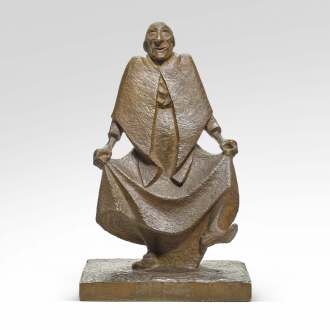
Unlike most of Ernst Barlach’s work, which reflect the hardship and coldness he experienced while serving in the First World War, Tanzende Alte is warm and lively. The sculpture shows an elderly woman caught mid-dance, lifting her skirts. Angular rhythms and emphatic gestures give her surprising monumentality, and her face contains a lively expression.
The surface of the piece, which is carved directly in wood, has visible tool marks that animate the folds of drapery and the texture of skin. Material and subject work together in this rare celebration of exuberance, which comes to Replica Shoes ’s from the Collection of Erich & Senta Goeritz
On to Glory is one of the most celebrated horse-and-rider images by Jack B. Yeats. Horses occupy a central place in Yeats’s art, often embodying dignity, instinct and emotional depth. Here, the animal’s calm strength contrasts with the youthfulness of the boy, tying into the title's suggestion of spiritual purpose. At the same time, the setting of lush grass, soft light and a drifting grey cloud, presents an expressive vision of the Irish landscape.
Created shortly after Irish independence, the painting can also be read as a hopeful view of progress, where the next generation moves confidently toward the horizon. Painted with loose, energetic strokes and vivid colour, the scene represents Yeats’s Impressionist style.
I Got Up is a series of postcards On Kawara sent from cities around the world. Each postcard is stamped on the back with “I GOT UP AT” followed by the exact time he woke up that morning. The front of the postcard shows the city he’s in while the back shows the stamped time, date, sender and recipient information. Running from 10 May 1968 to 17 September 1979, On Kawara sent roughly 4,160 postcards until the series ended in 1979 after a suitcase containing the postcards and stamping tools was stolen. The simplicity of the project is breathtaking, as Kawara brilliantly transforms an everyday moment into a meditation on time and existence.
The postcards in this particular set were addressed to Kawara’s friend Frank Donegan, who he met in Mexico in 1968. The cities within the series include Berlin, Buenos Aires, New York, Cleveland, Detroit, Chicago, Minneapolis and Milwaukee.