The Contemporary Art Specialist

An enormous metallic tapestry supports the Royal Academy Schools, reflecting creativity as a fabric woven from education, history and collective making.
By Mackie Hayden-Cook
Specialist, Contemporary Art
My first introduction to Ghanaian sculptor El Anatsui was in 2013—one of those formative encounters that changes everything. “TSIATSIA—Searching for Connection,” his contribution to the Royal Academy’s Summer Exhibition, draped across the 1720s Palladian façade of Burlington House on London’s Piccadilly. A vast metallic cloth of thousands of recycled bottle tops, it was audacious yet tender—a technical and poetic feat, enveloping the institution in something alive.
Over a decade on, that moment finds elegant reprise. Anatsui’s “G6,” from 2023, will be offered in support of the Royal Academy Schools, whose tuition-free, three-year program has long been the U.K. capital’s rarest and most radical gift to students worldwide. His gesture now feeds directly into the Schools’ lifeblood—studios and critiques, lectures and exhibitions, the making and debating behind those historic walls—sustaining the program housed within the building his work once adorned.

Back in 2013, I was studying sculpture and art history at Newcastle University, stomping around in a fireproof jumpsuit, steel-capped boots and full PPE as if always on my way to extinguish a small blaze. I spent my days casting, carving and welding. Sculpture fascinated me for how objects behave around bodies. I immersed myself in the theoretical writings on phenomenology, and my dissertation circled the hulking gestures of 1960s minimalist sculpture—those cool, declarative forms that insist you reckon with your own physical presence. While I looked back, something extraordinary was happening in the present.
“TSIATSIA” caught my imagination because it declared Anatsui’s unique grammar of making. His invented technique bends traditional processes to yield improbable forms—pushing metal to behave like cloth. Through cutting, folding, piercing and stitching, he alchemizes the detritus of global consumption into works of profound beauty. After the Summer Exhibition, accolades followed, and in 2014 he was elected an Honorary Royal Academician. Yet what lingers is not the tally of distinctions, but the recognition of an artist articulating, at monumental scale, the very principles art school tries to teach—attention, precision, experimentation, trust, risk, patience; faith in materials, process and one’s own ability.
“G6” presents itself as a vibrant field of color and texture: ivory, gold, scarlet, black and deep indigo coalesce into rhythms between abstraction and figuration. From afar, it reads as a sumptuous mantle; up close, its construction reveals flattened, pierced fragments of metal, each carrying traces of a former life. Within this vertical composition, six ghostly figures emerge. The materials seduce, yet they also speak. In West Africa, liquor bottles and alcohol hold complex social meanings and, under colonial trade, became potent commodities. Anatsui’s bottle caps are thus freighted with histories of circulation between Africa, Europe and the Americas. Like all of his mature wall sculptures, “G6” exists in a state of perpetual becoming, its final form shaped by gravity, installation and the choreography of folds and seams that take on a life of their own.
Few experiences shape both career and character as profoundly as art school. Years later, when I began working at Replica Shoes ’s, Anatsui’s works appeared first in the Modern and Contemporary African sales before migrating into marquee Contemporary auctions. After all that movement and making, I found myself once again in his orbit. “G6” feels like a reunion and the cleanest kind of circuit: the market in service of mentorship, brilliance underwriting access and transformation sustaining the very structures from which new practices emerge.


The Chinese Works of Art Specialist

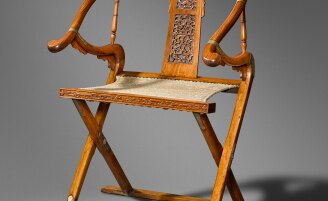
A rare 17th-century Ming folding chair reflects a culture of craftsmanship that inspired 20th-century design masters.
By Angela McAteer
International Head of Department, Chinese Works of Art, Americas & Europe
Fewer than 30 huanghuali horseshoe-backed folding chairs from the Ming dynasty are known to survive, yet each offers a remarkable window into this era of extraordinary craftsmanship and refinement. It was this period—central to our understanding of Chinese art and material culture—that first sparked my personal interest in the field. Known as the empire of “Great Brightness,” the Ming ruled China from 1368 to 1644, following the collapse of the Mongol-led Yuan dynasty. Its founding marked a renewed emphasis on Confucian values, classical learning and cultural continuity. For later generations, the Ming became a cultural touchstone, its art embodying balance, restraint and moral clarity.
These ideals are clearest in the arts of everyday life. Nowhere is this more evident than in furniture, which reached a synthesis of elegance, functionality and craftsmanship. This folding chair, known as a jiaoyi and crafted from prized huanghuali wood, is one of the most notable survivals of Ming material culture, a tangible connection to the cultivated interiors of scholars, collectors and courtly elites, spaces for reading, conversation and contemplation.

Today, classical Chinese furniture is highly prized again, noted for its use of dense hardwoods such as huanghuali, zitan and jichimu, materials valued for their strength and rich grain. Rather than relying on applied ornament or surface decoration, Ming furniture emphasized purity of form, structural clarity and the highest standards of workmanship. Beauty lay in proportion, subtle curves, and the wood’s expressive character. Huanghuali, in particular, was prized for its texture and striking grain, ranging from honey-gold to deep russet tones, lending a quiet sense of luxury to restrained designs.
The chair’s U-shaped crest rail, known as a “horseshoe back,” is one of the most recognizable forms of classical Chinese furniture, later inspiring 20th-century designers Hans Wegner, George Nakashima and Finn Juhl. The folding version of the horseshoe-back chair was first developed during the Song dynasty, around the 12th century, and represents a uniquely Chinese solution that combines mobility with a dignified presence. When folded, the front seat rail fits within the curved supporting arms—an ingenious detail reflecting technical mastery and aesthetic restraint. Discreet metal bracing strengthens the joints without disrupting the visual harmony.
Yet the folding mechanism’s complexity made it vulnerable to damage. Today, few survive, most preserved in museum collections. One celebrated example was sold in our Hong Kong rooms in 2022 as part of the collection of Sir Joseph Hotung, where it realized the equivalent of $15.8 million, setting a world auction record for a Chinese chair and the third highest price for any chair sold at auction. In every curve and joint, these chairs tell the story of a time when form, function and philosophy were inseparable.