I
t is not often that a disagreement between friends leads to an auricular severance, but this is exactly what happened with Vincent van Gogh and Paul Gauguin. After spending weeks living and working together in the south of France, the pressure of their devolving friendship, their conflicting views on art, and underlying mental illness led van Gogh to remove part of his ear — and then memorialize it in two significant self-portraits.
Art is not, after all, a neat succession of movements but instead has been shaped by culture and politics, illness and joy, innovation and nostalgia. Perhaps, above all, it is connections between people that transform art as we know it and a few relationships in particular have helped to define many artistic styles that are crucial to contemporary art today.
This week, Replica Shoes ’s announced a partnership with London’s Royal Academy of Arts which will culminate in an auction to support the RA's three-year, free-tuition postgraduate program as well as their exhibitions, collections, library and archive. As part of our Modern & Contemporary art sales, works donated by the artists themselves — Sean Scully RA, El Anatsui Hon. RA, Tony Cragg RA, Anish Kapoor RA, and Jeff Koons Hon. RA included — will be auctioned with the express purpose of championing future generations of artists. In honor of this sale, we look back at the rich history of artists supporting artists, highlighting some of the key moments and oeuvres-shifts that may have shifted the course of an artist’s life and work.
Camille Pissarro and Cezanne
Camille Pissarro met Paul Cézanne at the Academie de Charles Suisse in Paris in the early 1870s. They painted together extensively in Pontoise and Auvers-sur-Oise, working en plein air and exchanging technical advice. Pissarro encouraged Cézanne to work directly from nature, loosen his brushwork, and abandon academic rigidity.
For over 20 years, Cézanne and Pissarro appreciated each other's influence and experimentation. While Pissarro remained committed to Impressionist principles of light and atmosphere, Cézanne moved toward a more structural approach. Despite their differences, they encouraged each other to evolve in their work freely through Impressionist art and landscape painting.
Claude Monet and Pierre-Auguste Renoir
Claude Monet and Pierre-Auguste Renoir met in their mentor Professor Charles Gleyre’s studio in 1862. Many of their works illustrate the same subject (perhaps most famously, La Grenouillerie), and they often worked together en plein air painting in the countryside of France and along the Seine River. Many scholars believe that their side-by-side way of working produced a healthy competition that pushed both artists to define and refine their individual styles.
Although closely aligned on their light and landscapes, they were reportedly very different in temperament. This difference reflected in their art as well: Monet pursued seriality and atmospheric variation while Renoir focused on the figure, eventually rejecting aspects of Impressionism altogether. Still, they remained close friends with Renoir visiting Monet at Giverny in their later years.
Vincent van Gogh and Paul Gauguin
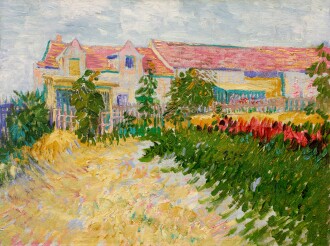
In 1888, Vincent van Gogh invited Paul Gauguin to Arles in hopes of creating a communal space where artists could live and work together outside of Paris. In the nine weeks they spent together, the artists exchanged ideas and styles. Van Gogh painted The Yellow House and sunflower canvases, while Gauguin completed The Vision After the Sermon shortly after leaving. Gauguin's primitivism contrasted well with van Gogh’s brushwork and vibrant color choice.
Despite being close friends at the time, they had strong disagreements. With contrasting dispositions and views on art, van Gogh painted from feeling and observation while Gauguin focused on symbolism and imagery. Their disagreements came to a climax when Gauguin abruptly departed Arles, and van Gogh cut off a small section of his ear and was hospitalized.
Despite their tumultuous relationship, the artists learned from each other,developing new techniques and color theories together, such as non-naturalistic color and symbolic, outlined forms. Their artistic legacies are intertwined, accelerating the move toward Post-Impressionism and future artistic experimentation.
Man Ray and Marcel Duchamp
Man Ray and Marcel Duchamp met in New York in 1915 while playing a spontaneous game of tennis. They quickly bonded over yet another two-player game, chess, and a shared skepticism toward traditional artmaking. Duchamp’s Fountain would go on to profoundly shape Man Ray’s thinking, encouraging him to find inspiration in humor. When they both moved to Paris in the 1920s, they joined the Dada and Surrealist circles.
Man Ray photographed Duchamp extensively, including his alter ego Rrose Sélavy, and helped disseminate Duchamp’s ideas visually. Duchamp, in turn, supported Man Ray’s experiments in rayographs, film and assemblage. Unlike many artistic partnerships, they were not rivals and remained friends even after Duchamp retired from art at age 31.
Grandma Moses and Norman Rockwell
One of the most endearing friendships in American art existed between illustrator Norman Rockwell and self-taught painter Anna Mary Robertson Moses, known as Grandma Moses. Moses did not begin making paintings until her late seventies, around the time Rockwell relocated from New York City to rural Arlington, Vermont. There, they became neighbors.
Despite differences in training and reputation, they were drawn together by a shared interest in scenes of ordinary life in America. They focused on rituals and tradition along with the patterns of everyday experience. Grandma Moses’s ideas inspired Rockwell, and he painted her in the background of his Christmas Homecoming painting, which depicted a joyful family reunion.
Their shared interests created a close friendship and the two spent considerable time together. In 1948, on Moses' 88th birthday, Rockwell famously arrived at her home bearing an oversized cake to celebrate.
Helen Frankenthaler and Grace Hartigan
Helen Frankenthaler and Grace Hartigan were both successful abstract artists and each separately exhibited at the Tibor de Nagy Gallery and participated in debates around abstraction and gesture. Today, they are considered leaders of the Abstract Expressionist movement.
Rather than direct artistic impact, their relationship demonstrated a mutual repudiation of the male-dominated art scene of 1950s New York. Hartigan’s work was more figurative than Frankenthaler’s and resisted the impersonal direction abstraction was taking. While Frankenthaler’s work gained institutional support, Hartigan increasingly turned to figurative imagery, drawing from Old Masters and contemporary poetry. Still, the two supported each other's work throughout their lives through friendship and discussion.
Lucian Freud and Francis Bacon
Lucian Freud and Francis Bacon became friends in London in the 1940s, and spent time together almost every day for the next 25 years. Despite their 13-year age gap, they drank, gambled and engaged in intense discussions about painting. They also painted each other in Freud’s Portrait of Francis Bacon and Bacon’s Three Studies of Lucian Freud.
Despite their influence on each other, their approaches differed sharply and they often criticized each other's work. Bacon embraced distortion while Freud worked slowly through observation. As Bacon’s fame increased in the 1970s, tensions in their friendship arose and their friendship declined later in their lives.