
Property from the New-York Historical Society
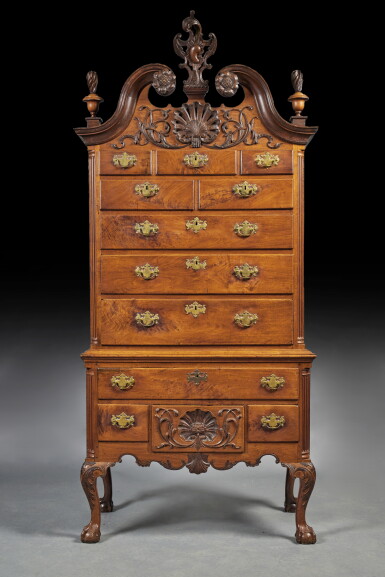
The Important Mrs. J. Insley Blair Chippendale Carved And Figured Walnut Scroll-Top High Chest of Drawers, Case attributed to Henry Clifton (c. 1725-1771) and Thomas Carteret (act. 1753-1765), Carving attributed to 'Spike', Philadelphia, Pennsylvania, Circa 1760
Auction Closed
January 23, 04:26 PM GMT
Estimate
150,000 - 250,000 USD
Lot Details
Description
The Important Mrs. J. Insley Blair Chippendale Carved And Figured Walnut Scroll-Top High Chest of Drawers
Case attributed to Henry Clifton (c. 1725-1771) and Thomas Carteret (act. 1753-1765)
Carving attributed to 'Spike'
Philadelphia, Pennsylvania
Circa 1760
Appears to retain its original cartouche, urn-and-flame finials and cast brass hardware. Carved elements retain an earlier undisturbed finish. Central plinth beneath cartouche partially replaced.
Height 98 3/4 in. by Width 45 1/4 in. by Depth 24 in.
William W. Smith, Hartford, Connecticut;
Charles Woolsey Lyon, New York;
Mrs. J. Insley (Natalie Knowlton) Blair (1883-1951), Blairhame, Tuxedo Park, New York;
to her daughter, Mrs. Screven (Natica Blair) Lorillard (1913-1955), Far Hills, New Jersey.
Luke Vincent Lockwood, Colonial Furniture in America, (New York: C. Scribner's Sons, 1926), pp. 107-8, fig. 105;
Robert William Glenroie Vail , Knickerbocker Birthday: A Sesqui-Centennial History of the New-York Historical Society, 1804-1954, (New York: New-York Historical Society, 1954), p. 319;
Helen Comstock, American Furniture: Seventeenth, Eighteenth, and Nineteenth Century Styles, (New York: Viking, 1962), no. 310.
Made of richly figured walnut and elaborately ornamented with exceptional carving, this high chest stands as an iconic and important example of Rococo style case furniture from pre-Revolutionary Philadelphia. It survives as one of the best preserved of its form, retaining its original cartouche, finials, rosettes, applied carved elements, and cast brass hardware.
The early history of this chest is unknown before 1926, when it appears illustrated by Luke Vincent Lockwood in Colonial Furniture in America as the property of Mr. William W. Smith of Hartford. By 1932, it was in the American furniture collection of Mrs. J. Insley Blair (Natalie Bennett Knowlton) (1883-1951) at Blairhame, her house in Tuxedo Park, New York. It appears in a photograph on Mrs. Blair’s Bedroom taken at Blairhame in December of 1932.1 At Mrs. Blair’s death in 1951, the high chest became the property of her daughter Mrs. Screven (Natica Blair) Lorillard, who gave it in her mother’s memory to the New-York Historical Society in 1954. While in the collection of the New-York Historical Society, this chest has been lauded as having “carved rococo ornament of the highest order” and “a flowing scrollwork of acanthus treated with a freedom and breadth rarely seen in American work.”2
This high chest is attributed to the Philadelphia cabinet shop of Henry Clifton (c. 1725-1771) and Thomas Carteret (active 1753-1765), two enterprising Quaker cabinetmakers who were members of the Philadelphia monthly meeting. Henry Clifton is recorded in Philadelphia in 1748, when he purchased medicine from Dr. Preston Moore and paid with a fire screen made for Moore’s wife. He made clock cases for John Wood and a set of chairs for Dr. Richard Hill in 1759. He worked in partnership with James Gillingham from the early 1760s to 1768, after which time he advertised as a joiner and chairmaker at a shop of Arch Street in 1770.3 The attribution to the Clifton-Carteret shop is based upon a very closely related high chest of drawers at Colonial Williamsburg signed “Henry Cliffton/Thomas Carteret” and dated November 15, 1753.4 From the pitch of the pediment, to the flame finials, careful placement of the figured wood, drawer arrangement, shell carved lower drawer, skirt profile, carved knees and claw feet, this high chest closely follows the form of the signed high chest and likely represents the same shop tradition.
The distinctive carving on the center of the tympanum comprised of a smaller shell within a pierced larger shell with ruffled edges is a particular variant of Rococo carving that is associated with the Clifton-Carteret shop. This carving appears on a small group of high chests attributed to the shop: one of mahogany with its original finials, rosettes and brasses that descended in the family of John Morin Scott of Germantown, Pennsylvania, the first popularly elected Mayor of Philadelphia, that sold in these rooms, Important Americana, June 23-24, 1994, sale 6589, lot 273,5 another of mahogany with its original cartouche and brasses in the collection of the Detroit Institute of Arts that was formerly in the collection of the Brixey family and later the collection of Mr. and Mrs. Charles Gershenson of Detroit,6 a third example made of mahogany likely made for Benjamin Marshall (d. 1778) that was formerly in the collection of the Chipstone Foundation and currently in a private collection,7 and a high chest in the collection of the DeYoung Museum in San Francisco that was owned by Benjamin Hartley of Philadelphia. Of the high chests in the group, this one is most similar to the one owned by John Morin Scott in the treatment of the shells and flowing acanthus tendrils on the tympanum and drawer, stance of the cabriole legs, acanthus carving of the knees, and boldly carved claw and ball feet.
The finely rendered carving on this high chest relates closely to the work of an unidentified carver nicknamed “Spike” by Alan Miller and Luke Beckerdite. This carvers work is characterized by elongated acanthus leaves and gouge cuts that run through the ends of the leaf tips and shell lobes. Miller has noted that “Spike” was an important carver working in Philadelphia in the 1760s and early 1770s.8 His body of work includes the Lawrence-Palmer high chest and en suite dressing table at the Metropolitan Museum of Art9, the Wistar-Sharpless desk-and-bookcase at the Philadelphia Museum of Art, and the skirt applique and molding of a slab table in the collection of the U.S. Department of State.10 A dressing table with carving attributed to “Spike” was sold at Christie’s, Important American Furniture, Folk Art and Silver, January 24, 2020, lot 337.
1 Christie’s, New York, Property from the Collection of Mrs. J. Insley Blair, January 21, 2006, sale 1618, fig. 14, p. 23.
2 Helen Comstock, American Furniture (!962): no. 310.
3 Eleanore P. Gadsden, “When Good Cabinetmakers Make Bad Furniture: The Career and Work of David Evans,” American Furniture (Hanover and London, The Chipstone Foundation, 2001): pp. 69-70.
4 ibid, fig. 1, p. 66. See also Morrison Heckscher and Leslie Greene Bowman, American Rococo, 1750-1775: Elegance in Ornament (New York: Harry Abrams, 1992): fig. 47, p. 199.
5 The high chest was purchased by C.L. Prickett and appears illustrated in their brochure in 1995.
6 Accession number 73.3. The high chest was purchased at The Charles H. Gershenson Collection Public Auction held at H.O. McNierney, Stalker & Boos, Inc., in Birmingham, Michigan on October 23 and 24, 1972, lot 164.
7 Christie’s, Important American Furniture, Folk Art, Silver and Prints, May 19, 2005, lot 109. The dressing table made en suite with the high chest is in the same private collection.
8 Alan Miller’s catalogue entry for a Philadelphia slab table in Clement Conger and Alexandra Rollins, Treasures of State (New York, 1991): cat. 28, p. 108-9.
9 Morrison H. Heckscher, American Furniture in the Metropolitan Museum of Art (New York, 1985): nos. 166 and 167, pp. 255-8.
10 Philadelphia: Three Centuries of American Art (Philadelphia, 1976): cat. 84, pp. 104-5. See also Conger and Rollins, cat. 28, p. 108-9 and footnote 7, p. 109 for other pieces with carving attributed to this carver.
You May Also Like


