
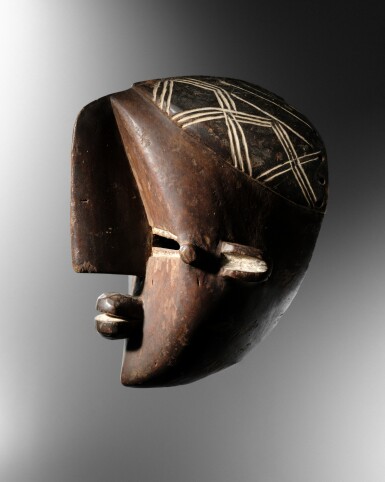
Lwalwa Mask, Republic Democratic of the Congo
Estimate
50,000 - 70,000 EUR
Lot Details
Description
Lwalwa Mask, Republic Democratic of the Congo
Height: 10 ¼ in ; Haut. 26 cm
Karel Timmermans Collection, collection in situ between 1962 and 1965, until 2006
Sotheby’s, Paris, December 5, 2006, lot 123
Pierre Dartevelle, Brussels, acquired from the above sale
Daniel Hourdé, Paris, 2012
Collection Daniel Hourdé, Paris
Charles-Wesley Hourdé Gallery, Paris,, L'emprise des masques, September 12-30, 2017
Paul Timmermans, "Les Lwalwa", dans Annales du Musée du Congo Belge, Tervuren XIII, 1967-3/4, p.82, no. 13B
Raoul Lehuard, "La collection Timmermans-Haems", dans Arts d'Afrique Noire, Arnouville, n° 48, Winter 1983, p. 41
Pierre Dartevelle, BRAFA 12. Brussels Antiques & Replica Handbags s Fair, January 2012, p. 157
Art Tribal/Tribal Art, XVI, 3, n° 64, 2012, p. 13 (adv. Daniel Hourdé)
Charles-Wesley Hourdé, L'emprise des masques, Paris, 2017, cover illus. and pp. 69-70, no. 20
Clément Thibault, "La voix des marchands", dans Art Media Agency (AMA) Newsletter Parcours des Mondes, 2017, p. 48
Valérie Dartevelle et Valentine Plisnier, Pierre Dartevelle et les Arts Premiers. Mémoire et Continuité, Vol.II. 5 Continents, 2021, pp. 392-393, fig. 504-505
By Charles-Wesley Hourdé
The Lwalwa mask presented here is one of the most beautiful of the known exemplars. It stands out for its balanced outlines and the fullness of its proportions. The highly stylised face tends towards abstraction. The concave face is punctuated by an expansive nose that takes root at the top of the forehead and then projects outwards in high relief. Reminiscent of a hornbill's beak, this appendage is framed by two rectangular eyes enhanced with kaolin. It overhangs a small mouth with full lips. The temples are adorned with raised scarification. A thin cord, fastened to a hole pierced beneath the nose, enabled the dancer to hold the mask in place with their teeth.
Karel Timmermans taught French in Luluabourg from 1959 to 1960, then from 1962 to 1965. He was introduced to African art by his brother Paul, who had founded a private museum there before going on to work at the Tervuren Museum in Belgium. Karel would travel around villages in then-Zaire to buy objects that were no longer in use. On one of these journeys, he acquired this magnificent Lwalwa mask.
Lwalwa masks with hook noses have often been associated with Picasso's work. The striking features of these idealised faces are reminiscent of certain paintings and sculptures by the Spanish artist, especially the series of portraits he made of his muse Marie-Thérèse Walter.
Related masks were displayed alongside his creations in major primitivist exhibitions: Primitivism in 20th Century Art and Picasso Primitif.
However, no one can say for sure whether Picasso ever had the chance to see them, as these masks were particularly rare in France before the Second World War. (Rubin, 1987, p.328). The influence of African art here is subliminal. “Primitive” objects weren't copied, they let the artist explore new artistic directions.
You May Also Like


