
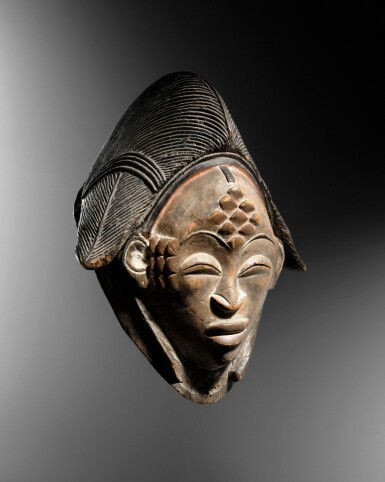
Punu Mask, Gabon
Estimate
70,000 - 100,000 EUR
Lot Details
Description
Punu Mask, Gabon
Height: 11 ⅞ in ; Haut. 30 cm
Monbrison Gallery, Paris
Robert "Bobby" Haas Collection, Paris and Dallas, acquired from the above
Christie's, Paris, Arts Primitifs, Vente II, June 15, 2002, lot 283SR
Monbrison Gallery, Paris, 2024
Daniel Hourdé Collection, Paris
Paris, Galerie Monbrison, Beauté Convulsive, 23-28 April 2024
African Arts, 1984, vol. XVII, no. 3 (adv. de Monbrison)
Beauté Convulsive, Paris, Galerie Monbrison, 2024, pp. 20- 21, n° 8
Today, the Punu form a small ethnic group in southern Gabon.
Westerners first discovered this region's art in the late 19th century. These objects soon captured the imagination of Western artists, as evidenced by a photograph taken in Picasso's studio in 1910.
Despite the lack of documentation and context, we do know a little about the rites, as reported by certain colonial administrators.
Punu masks come out during funeral rituals and initiation ceremonies. They are the main element of a costume known as Mukudj, worn during certain magical rituals to expose sorcerers who are harmful to the well-being of the community. During these performances, dancers on high stilts perform impressive acrobatic feats. Known as okuyi, mukuyi or mukudji depending on the region, these masks highlighted the beauty and importance of Punu women.
According to Alisa LaGamma discussing Punu art: “(…) Its relatively realistic aesthetic originates from Central Africa, but also from a context that has been mistakenly described as ‘Asian’, illustrating the idea of a vague and exotic ‘otherness’” (Forêts Natales Catalogue)
With its rich brown hue, this mask figures a peaceful female face. In a very naturalistic style, it is topped with a coiffure made up of a domed crest and two side locks that flare out above the ears. The lightweight wood has been meticulously striped to resemble sophisticated braiding. The sculptor also paid close attention to the finer details of the nostrils and outer ears. The sensuous lips appear to be forming a hint of a smile. The thin slits of the eyelids reveal the volume of the eyes, rendered subtly by a highly skilled sculptor.
Lastly, scarification patterns typical of the Punu adorn the temples and forehead. Just like the lips, they are enhanced with padauk red.
In this square or diamond-shaped motif made up of nine cheloid shapes, there may be a reference to the nine primordial clans which founded this population. It can equally evoke a sense of enigmatic and idealised feminine beauty.
This mask is closely related to a similar one held at the Fondation Dapper.
You May Also Like


