
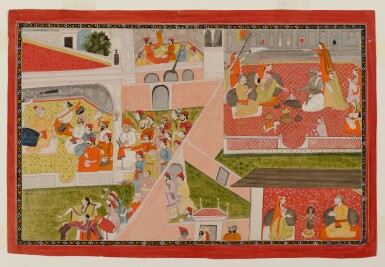
An Illustration to the Ramayana: the Miraculous Birth of Rama and His Brothers, Pahari / Jammu, circa 1830s
Estimate
9,000 - 14,000 USD
Lot Details
Description
black inner border with foliate designs and red outer borders, verso: 40+ lines of text in black and red ink Devanagari script
Image: 13⅛ by 21¼ in., 33.3 by 53.9 cm
Folio: 14½ by 22⅜ in., 36.8 by 56.9 cm
English private collection, prior to 1999.
Bonhams Knightsbridge, London, 1999.
Private collection.
In the rooms of the royal palace of Ayodhya, King Dasaratha and his attendants give thanks for the miraculous birth of Rama and his brothers. At the left the king and sage Narada (holding a stringed instrument) are seated with court attendants, joyful musicians and women dancing in celebration. From the Balakanda of the Ramayana.
On an upper terrace guru Vasishta performs the Putrakameshti Yajna ("son-getting") ceremony with King Dasaratha's three wives - Queen Kaushalya who gave birth to the baby Rama, Queen Kaikeya who holds baby Bharata and Queen Sumitra (and her attendant) holding the twins Shatrughna and Lakshmana. At the lower right Queen Kaushalya and King Dasaratha are seated in the presence of Vishnu.
The Ramayana narrates the story of Rama and his quest to rescue his wife Sita kidnapped by the evil asura king Ravanna. The birth of Rama is among the most beloved episodes of the Ramayana - a metaphor for the birth of virtue over evil as manifested in human form.
This unusually large-format folio exemplifies the narratively rich examples of Jammu painting in the early nineteenth century - with multiple scenes depicted across complex multi-level palace architecture. It exemplifies some of the finest qualities of the Jammu school in its maturity under the Dogra rulers during the early nineteenth century: the individualized facial expressions and gestures of the figures in the Jammu manner; the characteristic palette of deep reds, warm saffrons, cool greens, and luminous whites; delicately rendered Mughal-derived architecture with scalloped arches and latticed screens and a sophisticated use of diagonal rooftop and wall planes as a compositional device to organize simultaneous events across multiple spatial registers.
Another folio depicting the same episode of the Ramayana from Udaipur ca. 1712 is in the collection of the British Library (add. 15295 f.56). Another example from Malwa ca. 1650 "The Birth of Rama and His Three Brothers" is in the collection of the National Museum, New Delhi.
The present folio is larger in format than most comparable Pahari miniatures.
A closely related example was sold at Bonhams Knightsbridge, 21st April 1999 lot 482.
You May Also Like


