
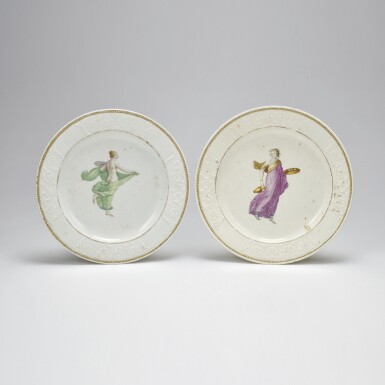
Two Naples Real Fabbrica Ferdinandea porcelain plates, late 18th century
Estimate
800 - 1,200 EUR
Lot Details
Description
each painted with a classical female figure holding objects within a foliate scroll and flowerhead-moulded border and gilt beaded border to the rim, one inscribed in brown on the reverse ‘MVS. ERCOL./SERIE DI PITTVRE/DONNA CHE DANZA/RITROVATA IN CIVITA’, the other inscribed in black on the reverse ‘MVS. ERCOL./SERIE DI PITTVRE/DONNA CHE DANZA IN ARIA/RITROVATA/NELLI SCAVAMENTI DI/CIVITA’
26,3 cm, 10 ⅜ in. diameter
Wannenes, Genoa, 29 February 2012, lots 10 and 11.
The decoration of these plates is closely related to that of the famed 'Servizio Ercolaneo', made by Real Fabbrica Ferdinandea manufactory between 1780 and 1782 and presented by Ferdinand IV (1751-1825), King of Naples and the Two Sicilies, to his father, Carlo III of Spain (1716-1788), in 1782. The iconography was taken after Pompeian frescoes, reproduced in the prints published in eight volumes of Le Antichità di Ercolano esposte, published between 1757 and 1798, by the Accademia Ercolanese founded in 1755 on the orders of King Carlos III. The present pair share similar decoration to the royal service, and the same moulded and beaded borders, but lack the painted border vignettes. For a more in-depth examination of the 'Servizio Ercolaneo', see A. Caròla-Perrotti, Le Porcellane dei Borbone di Napoli, Capodimonte e Real Fabbrica Ferdinandea, 1743-1806, exhibition catalogue, Naples 1986, pp. 327-329.
Related Literature:
A. Caròla-Perrotti, Le Porcellane dei Borbone di Napoli, Capodimonte e Real Fabbrica Ferdinandea, 1743-1806, exhibition catalogue, Naples 1986, pp. 327-329.
Museo Nazionale di Capodimonte, Ceramiche, porcellane, biscuit, terraglie, maioliche, p. 75, nos. 2.95, 2.96 and 2.97.
Civiltà del '700 a Napoli 1734-1799, exhibition catalogue, Florence, 1980, vol. II, pp. 72-73, no, 326a-c.
You May Also Like


