
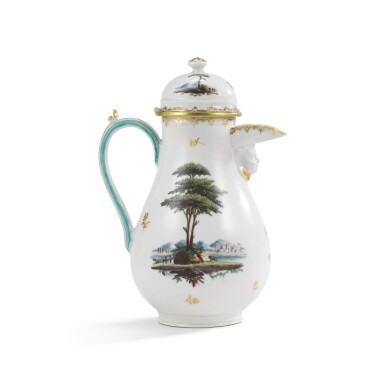
A Cozzi porcelain small coffeepot and cover, circa 1770-75
Estimate
1,200 - 1,800 EUR
Lot Details
Description
of baluster form, moulded with a boy mask below the spout, painted on one side with a landscape vignette with figures, a river and buildings in the distance, the other side with a gilt scroll and floral ‘BC’ monogram below a flower garland, with scattered gilt flower sprigs, the domed cover with two small landscapes, gilt scroll borders to the rims, anchor mark in iron-red enamel
19 cm, 7 ½ in. high
T.D Collection (1981);
Private Collection (1997).
Ca’ Rezzonico, Venice, La Porcellana di Venezia nel '700, Vezzi, Hewelcke and Cozzi, 20 February - 20 May 1998.
F. Stazzi, Le porcellane veneziane di Geminiano e Vincenzo Cozzi, Venice, 1981, col. pl. XLVII;
F. Pedrocco, La Porcellana di Venezia nel '700, Vezzi, Hewelcke and Cozzi, exhibition catalogue, Venice, 1997, p. 57, cat no. 69.
Germiniano Cozzi, an imaginative entrepreneur and banker, created the most successful Venetian porcelain factory of the late 18th century. He became involved in the porcelain business, first as a partner with Nathaniel Friederich Hewelcke, who had founded his porcelain factory in 1761. In 1763, however, the factory went bankrupt and Hewelcke went back to Germany. Germiniano Cozzi then started up his own factory on the Caneraggio, and was soon afterwards offered support from the Senate and Venetian authorities. The factory grew rapidly, employing 50 people, including 7 painters, 7 potters and 2 sculptors, with a shop in Campo San Salvador. Its great strength was firstly to source proper kaolin in Italy (in the cave del Tretto, near Vicenza) instead of importing it illegally from Saxony. Secondly, the factory adapted its production to its clientele, creating less costly creamware for the wider public and high quality porcelain for the nobility. Overall, figures and tableware thus pleased a very large international clientele, either imitating creations from other factories, especially Meissen, or being a new design from the factory itself. The teapot and a larger coffeepot from this service are illustrated by F. Stazzi, Le porcellane veneziane di Geminiano e Vincenzo Cozzi, Venice 1981, col. pl. XLVII and F. Pedrocco, La Porcellana di Venezia nel '700, Vezzi, Hewelcke and Cozzi, exhibition catalogue, Venice, 1997, pp. 57-58, cat nos. 68 (teapot) and 71 (larger coffeepot).
You May Also Like


