
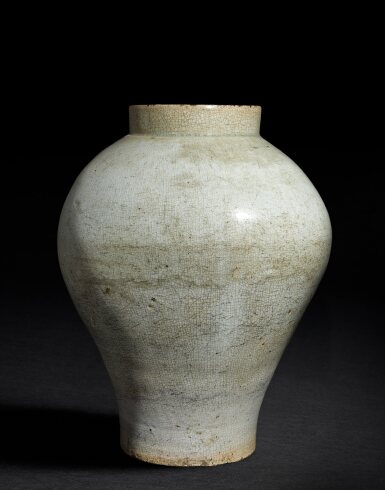
A rare and massive white-glazed jar, Joseon dysnasty, 18th century | 朝鮮王朝 十八世紀 白瓷大罐
Live auction begins on:
March 29, 10:00 AM GTNN
Estimate
600,000 - 1,600,000 HKD
Lot Details
Description
Japanese box
33.5cm wide x 42.3cm high
Ichigendo, Tokyo
東京古美術一元堂
The 22nd Special Triennial Tobi Art Fair - 60th Anniversary Antique Dealers' Fair & Exhibition in Tokyo, Tokyo Art Club, 12-14 October 2024, cat. no.2
第22回東美特別展 - 60周年紀念東美特別展 ,東京美術俱樂部,2024年10月12-14日,圖錄編號2
White: Not a Colour, But t.mes — Joseon White Porcelain
In Joseon white porcelain, white has never been just a colour.
It is not a hue that has been mixed or a result achieved at the end of firing.
Instead, it feels more like an unfinished state, an open surface preserved by t.mes .
On the day it is fired, white porcelain may seem complete.
The form is upright, the glaze pristine, the sheen soft.
Yet the true transformation begins only from that moment.
White is not the endpoint.
White is the entry point through which t.mes enters the object.
The Beginning of White Porcelain
After the establishment of the Joseon dynasty in the 15th century, white porcelain became a central focus of production in official kilns.
Originally, it was crafted for the royal court, government offices, and ceremonial purposes.
Its forms pursued symmetry, restraint, and order.
There was no elaborate decoration, no excessive embellishment.
Even so, this white was never absolutely pure.
Between the clay body and the glaze, subtle variations always appeared:
At t.mes s, it carried a faint bluish tinge; at others, a milky hue; somet.mes s, it leaned towards greyish white.
These slight inconsistencies were not flaws.
They were simply the honest expression of the clay itself.
Joseon white porcelain did not seek to conceal these differences.
It simply allowed them to exist.
White and t.mes
When a piece of white porcelain leaves the kiln, it truly begins its journey through t.mes .
Tea, water, air, and human touch gradually leave subtle traces on the glaze.
These changes are not immediate and do not happen overnight.
Somet.mes s, they take ten years.
Somet.mes s, they take a generation of use.
The white glaze slowly grows more lustrous.
The once-sharp rim softens, worn smooth by fingers and lips.
The base, where it.mes ets the surface of tables, quietly accumulates faint marks.
These changes do not alter the object’s shape.
But they transform the spirit of its whiteness.
White is no longer just a glaze.
It becomes a story, a passage of t.mes .
It is extremely rare to find Joseon white-glazed jar of this distinctive form produced during the 18th century. Only few comparable examples have been published, including a larger example in Nihon Mingeikan, Tokyo, see Nihon Mingeikan shozo Chosen toji mokuroku (Catalogue of Joseon-dynasty ceramics in the Nihon Mingeikan), pl. 48; and Rhee Byung-chang, Richo toji Yi Ceramics, in Kankoku bijutsu shusen Masterpieces of Korean Art , Tokyo, 1978, no. 158. See another related jar in the Samsung Art Museum, Joseon paekja jon (Exhibition of Joseon-dynasty white porcelain), Part 1, Seoul, 1983, no.34.
白:不是顏色,而是時間 ——李朝白瓷
白,在李朝白瓷中,從來不是一種顏色。
它不是一種被調製出來的色彩,也不是窯火結束時所獲得的結果。
它更像是一種尚未完成的狀態,一種被時間保留下來的開放表面。
在燒成之日,白瓷看起來已經完成。
器形端正,釉面潔淨,光澤柔和。
然而真正的變化,恰恰從那一刻才開始。
白,並不是終點。
白只是時間進入器物的入口。
白瓷的開始
朝鮮王朝十五世紀建立之後,白瓷成為官方窯場的重要燒造對象。
它原本是為王室、官府與禮儀系統而製作的器物。
在形式上,它追求端正、節制與秩序。
沒有繁複的裝飾,也沒有過多的表現。
但即便如此,這種白仍然不是絕對的純淨。
在胎土與釉之間,總會出現極細微的差異:
有時微微泛青,有時略帶乳色,有時則接近灰白。
這種並不統一的白,並不是缺陷。
它只是泥土本身的誠實。
李朝白瓷並不試圖隱藏這種差異。
它只是允許它存在。
白與時間
當一隻白瓷器物離開窯場之後,它才真正開始進入時間。
茶、水、空氣與人的手指,會慢慢在釉面留下極細微的變化。
這種變化並不明顯,也不會立刻發生。
有時需要十年。
有時需要一代人的使用。
白釉會逐漸變得溫潤。
原本銳利的口沿會被手指與嘴唇磨得柔和。
底足與桌面接觸的地方,則慢慢留下淺淺的痕跡。
這些變化不會改變器物的形狀。
但它們會改變白的氣息。
白,不再只是釉面。
它開始成為一段經歷。
此類造型的大罐又被稱為立壺,在十八世紀製作的朝鮮白瓷中,這種獨特造型的作品極為罕見。已出版的可比例子寥寥無幾,其中包括一件尺寸更大的例子,現藏於東京日本民藝館,參見《日本民藝館所藏朝鮮陶瓷目錄》(Nihon Mingeikan shozo Chosen toji mokuroku),圖版48;以及一件記載於李丙燦(Rhee Byung-chang)著作《李朝陶瓷》(Richo toji Yi Ceramics),收錄於《韓國美術集選》(Kankoku bijutsu shusen Masterpieces of Korean Art),東京,1978年,編號158。另可參考一件相關的罐,現藏於三星美術館,見《朝鮮白瓷展》(Joseon paekja jon),第一部分,首爾,1983年,編號34。
You May Also Like


