
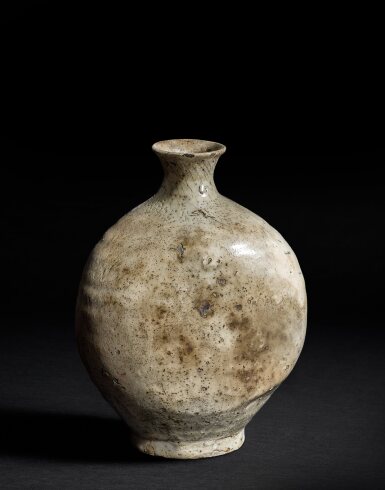
An Amamori kohiki vase, Joseon dynasty, 15th-16th century | 朝鮮王朝 十五至十六世紀 粉引扁壺
Live auction begins on:
March 29, 10:00 AM GTNN
Estimate
2,800,000 - 4,800,000 HKD
Lot Details
Description
double Japanese wood box
18.7cm high
collects ion of Shigeru Kōyama (1929-2017), Kyoto
神山繁(1929-2017年)收藏,京都
Utensils for Serving Sake: Special Spring Exhibition, Chado Shiryokan, Tokyo, 1991, no. 31
《酒器:平成三年春季特別展》 ,茶道資料館,京都,1991年,編號31
Rokusho 4: Tokkuri and Guinomi: Sake Vessels, Maria Shobō, Kyoto, 1991, p.15
Utensils for Serving Sake: Special Spring Exhibition, Chado Shiryokan, Tokyo, 1991, no. 31
The Appreciation of Antiques: Sake Flask and Cup, Heibonsha Ltd., Tokyo, 1994, p.107
Kōyama Shigeru, The Drinker’s Vessels, Yukawa Shobō, Kyoto, 2004, pp.21 and 79
Me no Me [Mind’s Eye], Issue 473, Tokyo, February 2016, pp. 26 and 38
The Japan Ceramic Society, Tosetsu, No.823, Tokyo, December 2021 - January 2022, p.064
《古美術 緑青4:徳利とぐい呑み》,マリア書房,京都,1991年,頁15
《酒器:平成三年春季特別展》 ,茶道資料館,京都,1991年,編號31
《別冊太陽:骨董をたのしむ1 - 徳利と盃》,平凡社,東京,1994年,頁107
神山繁,《酒鬼的器皿》,湯川書房,京都,2004年,頁21及79
《目の眼》,473號,東京,2016年2月,頁26及38
日本陶磁協會,《陶說》,823號,東京,2021年12月-2022年1月,頁064
Used White: Kohiki Tokkuri and the Form of t.mes
White has never been a stable color.
In the ceramic history of the Joseon dynasty, vessels known as kohiki were originally utilitarian wares, their surfaces covered in a layer of white slip. These objects were neither created for the court, nor imbued with ritual or symbolic meaning. White was simply a practical choice; the vessel existed to contain and to pour.
Yet, when these objects crossed the sea in the sixteenth century and began to circulate—used repeatedly, passed from hand to hand, placed in banquets and gathering halls—white began to change.
Alcohol seeped into the microscopic pores of clay and glaze. Repeated handling smoothed the lip and shoulder of the vessels. t.mes left mottled stains and pitted traces across their surfaces. White was no longer a mere covering; it became a revelation. The vessel was no longer fixed at the moment of its firing but continued to take shape through use.
The kohiki tokkuri presented in this exhibition are vessels completed in precisely this way—through t.mes .
From Utilitarian Vessel to Landscape: The Transformation of the Tokkuri
The tokkuri is a vessel for alcohol.
Its form arose from the requirements of handling and pouring: a rounded body, a short neck that flares outward, and a contour that does not insist on strict symmetry. These features were designed for use, not display.
For this very reason, the tokkuri absorbed t.mes earlier than the tea bowl. The penetration of liquid, traces of washing, and minute losses of surface gradually created textures that cannot be replicated. The white slip thinned, fractured, and revealed the clay beneath, forming what later came to be called amamori or “rain-leakage” patterns.
Within the cultural contexts of tea and alcohol in Japan, such changes were no longer regarded as deterioration but were reinterpreted as part of the vessel’s life. The tokkuri came to be left upon the mat, becoming a quiet presence within space—not something to be shown, but something to be felt.
An Unfinished Completion: The Temporality of Kohiki
Unlike inlaid punch’ŏng or white porcelain, kohiki vessels possess no definitive moment of completion.
They leave the kiln unfinished; they remain incomplete until they are used. True completion arrives only after decades of repeated use—when white relinquishes its purity and gains depth, when the surface loses its smoothness yet attains rhythm.
This is an aesthetic that entrusts completion to t.mes .
The value of the kohiki tokkuri lies not in the display of technical mastery but in the repeated intersections between human hands and the vessel, liquid and clay, t.mes and touch. By rejecting imagery and decoration, it compels the viewer to abandon explanation and turn instead toward perception.
The Vessel as Experience: A Way of Seeing
This exhibition does not seek to understand these vessels primarily through dynasty, date, or place of production.
Instead, it invites viewers to approach them slowly:
to observe layers of white rather than its purity;
to attend to irregular traces rather than perfected form;
to see how t.mes has inscribed itself upon the surface, rather than how the vessel was first intended to function.
The kohiki tokkuri does not ask to be admired.
It exists quietly, waiting to be understood.
Conclusion
These vessels were born for alcohol, yet became landscapes through t.mes ;
nameless at first, they acquired identity through use;
not made to be preserved, they were cherished precisely because they were used.
What we encounter in them is not a finished form, but an ongoing process.
This is why kohiki tokkuri continue to speak to us today.
The significance of kohiki tokkuri extends far beyond their original utilitarian purpose. In the context of the Japanese tea ceremony and the appreciation of sake, these vessels became highly revered for their rustic, unpretentious beauty, perfectly embodying the wabi-sabi aesthetic. Tea masters and collects ors prized them for their warmth, the tactile quality of the white slip, and the unique amamori (rain-leakage) patterns that developed over centuries of careful use, elevating them to the status of treasured cultural artifacts. This profound appreciation is perfectly exemplified by masterpieces such as the celebrated kohiki flask from the Museum of Oriental Ceramics, Osaka. Originally designed with functional subtleties, such as a small V-shaped spout for pouring and a slightly concave body to fit comfortably in the hand, it was transformed through generations of use. The smears and stains acquired over t.mes were cherished by tea masters as amamori, while exposed areas of the clay body and elegant lacquer or gold repairs only added to its charm. Passed down through the generations by the Maeda family of the Kaga domain (present-day Ishikawa Prefecture), it was favoured as a special sake bottle for kaiseki meals during tea gatherings, standing today as a test.mes nt to how the Japanese wabi taste elevates a simple utilitarian object into one of the greatest masterpieces of buncheong kohiki ware preserved in Japan, see Itoh Ikutaro, Bi no ryōken: Ataka korekushon yobun [Hounds of Beauty: Digressions on the Ataka collects ion], Osaka, 2007, cover.
Kohiki tokkuri vases and flasks are exceedingly rare, with the majority of extant examples currently housed in prestigious museum collects ions. Notable museum and gallery holdings of kohiki flasks and tokkuri vases include:
- Museum of Oriental Ceramics, Osaka: 2 flasks, 1 vase
- Umezawa Kinenkan Museum: 1 flask
- Tokugawa Art Museum: 1 flask
- Fukuoka Art Museum: 1 vase
- Gotoh Museum: 1 e-gohiki (painted kohiki) flask
- Tokyo National Museum: 1 vase
- Ishikawa Prefectural Museum of Art, Kanazawa: 1 e-gohiki flask
- Mitsui Bunko: 1 flask
- Nezu Museum: 1 vase
The closest comparable example to the present lot is the kohiki flask, formerly in the Ataka collects ion, currently in the Museum of Oriental Ceramics, Osaka (Acc. No. 20204). Another comparable example is a kohiki bottle in the Tokyo National Museum. Both are illustrated in Chōsen tōji shirīzu 8: Ritchō kohiki ten [Joseon Ceramics Series 8: Exhibition of Joseon Kohiki], Osaka, 1986, p. 4, nos. 1, cover and 3.
被使用的白 —— 粉引德利與時間的形態
白,從來不是一個穩定的顏色。
在朝鮮王朝的陶瓷史中,被稱為「粉引」的器物,原本只是以白化妝土覆蓋胎體的實用之器。它們既非為宮廷而制,也無意承載禮制或象徵意義。白,只是一種技術選擇;器,只是為了盛裝與傾注。
然而,當這些器物在十六世紀渡海而來,被反復使用、傳遞,置於酒席與會所之中時,白開始發生變化。
酒液滲入胎釉的微孔,手的觸摸磨潤了口沿與肩部,時間在表面留下斑駁的浸染與點蝕——白不再是「覆蓋」,而成為「顯現」。器物不再停留在燒成的瞬間,而是在使用中持續生成。
本展覽所呈現的粉引德利,正是這樣一種「在時間中完成」的器物。
從日用器到景色——德利的轉化
德利,是酒器。
它的形態源於把持與注酒的需要:圓鼓的腹部、短而外撇的口沿,以及不追求絕對對稱的輪廓。這些特徵,皆指向使用,而非展示。
正因如此,德利比茶碗更早承載了時間的痕跡。酒液的浸潤、洗滌的痕跡、細小的剝落,使其表面逐漸形成無法複製的肌理。白化妝土局部變薄、斷裂、顯露胎色,構成所謂「雨漏」的景象。
在日本茶與酒的文化語境中,這種變化不再被視為損耗,而被重新理解為器物的生命過程。德利被「留在席上」,成為空間中的一處靜默景象——不是被展示,而是被感受。
不完成的完成——粉引的時間性
與象嵌粉青或白瓷不同,粉引器物並不存在一個明確的「完成時刻」。
它在出窯時尚未完成,在被使用之前也尚未完成。真正的完成,是在數十年的反復使用之後——當白不再純淨,卻獲得深度;當表面不再平滑,卻產生節奏。
這是一種將「完成」交付給時間的美學。
因此,粉引德利的價值不在於展示工匠技藝,而在於人與器、液體與土、時間與觸摸之間的反復交會。它拒絕圖像與裝飾,迫使觀看者放棄解釋,轉而感受。
器物作為經驗——觀看的姿態
本展品並不試圖以王朝、年代或產地為中心來理解這些器物。
相反,我們邀請觀者以一種更緩慢的方式接近它們:
觀看白的層次,而非白的純度;
觀看不規則的痕跡,而非整齊的形態;
觀看時間如何在器物表面留下痕跡,而非器物最初被設想的用途。
粉引德利並不要求被讚歎。
它只是靜靜地存在,等待被理解。
結語
這些器物原本為酒而生,卻在時間中成為「景色」;
原本無名,卻在使用中獲得了名字;
原本不為保存,卻因被使用而被珍重。
在它們身上,我們看到的不是完成的形式,而是持續發生的過程。
這正是粉引德利至今仍能與我們對話的原因。
「粉引德利」的意義遠遠超越了其最初的實用功能。在日本茶道與清酒品鑑的文化語境中,這些器物因其質樸無華的美感而備受推崇,完美契合了「侘寂」(wabi-sabi)的美學精神。歷代茶人與收藏家對其珍愛有加,不僅因為其溫潤的觸感與白化妝土的獨特質地,更因為在數百年的精心使用中所孕育出的獨一無二的「雨漏」效果,使其躍升為備受珍視的文化瑰寶。這種深刻的審美在大阪市立東洋陶磁美術館所藏的著名粉引扁壺上得到了完美的體現。該器物最初的設計充滿了實用的巧思。如便於傾注的V形小流,以及貼合手掌的微凹腹部。但它卻在世代的使用中完成了升華。長年使用留下的斑駁痕跡被茶人們珍視為「雨漏」,而未施化妝土露出的胎體,以及優雅的金繕或漆繕修復痕跡,更增添了它的雅致與魅力。這件名品曾由加賀藩(今石川縣)前田家族世代相傳,在茶會的懷石料理中被用作特別的酒器。它無疑是日本傳世粉青粉引酒器中最偉大的傑作之一,也印證了日本「侘」之審美如何將一件簡單的實用器物推向藝術的巔峰,見伊藤郁太郎著,《美の猟犬: 安宅コレクション余聞》,大阪,2007年,封面。
能被稱為「粉引」的德利酒瓶及扁壺非常稀少,目前存世的大部分都被保存在博物館中,知名博物館及美術館的粉引扁壺與德利收藏記錄如下:
- 大阪市立東洋陶磁美術館:2件扁壺,1件瓶
- 梅澤紀念館:1件扁壺
- 德川美術館:1件扁壺
- 福岡美術館:1件瓶
- 五島美術館:1件粉引鐵繪扁壺
- 東京國立博物館:1件瓶
- 金澤石川縣立美術館:1件粉引鐵繪扁壺
- 三井文庫:1件扁壺
- 根津美術館:1件瓶
其中與本拍品最接近的可比較的,為大阪市立東洋陶瓷美術館收藏、前文提到的粉引扁壺(博物館編號20204),另外還可以比較一件東京國立博物館收藏的粉引瓶,見《朝鮮陶磁シリーズ8 李朝粉引展》,大阪市,1986年,頁4,編號1、封面及3。
You May Also Like


