
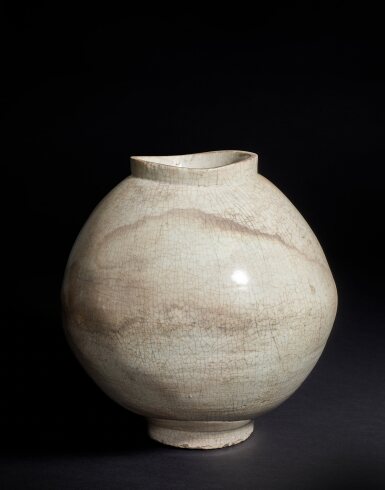
A white-glazed moon jar, Joseon period, 18th century | 朝鮮王朝 十八世紀 白瓷月亮罐
Live auction begins on:
March 29, 10:00 AM GTNN
Estimate
800,000 - 1,800,000 HKD
Lot Details
Description
Japanese wood box
33.5cm wide x 34.8cm high
Ichigendo, Tokyo
東京古美術一元堂
The 22nd Special Triennial Tobi Art Fair - 60th Anniversary Antique Dealers' Fair & Exhibition in Tokyo, Tokyo Art Club, 12-14 October 2024, cat. no.3
第22回東美特別展 - 60周年紀念東美特別展 ,東京美術俱樂部,2024年10月12-14日,圖錄編號3
Joseon White Porcelain: White as Stillness
Joseon white porcelain, especially the moon jar, embodies a white that has already settled.
Its whiteness is neither sharp nor eager to assert its purity.
The form approaches symmetry, yet always carries a subtle deviation;
the glaze appears even, but is never truly flat.
This whiteness does not seek to erase the clay body,
but allows the form to emerge through silence.
The white of the moon jar asks nothing of the viewer.
It does not demand interpretation,
nor does it hurry toward use.
Here, white has withdrawn into the background, becoming a field
in which space and t.mes are allowed to remain.
Universally admired for its luminous white porcelain surface, elegant, gravity-defying proportions, and charming idiosyncrasies, the evocatively named moon jar (dalhangari) epitomizes the nuanced, natural beauty acclaimed in Korean ceramics. Completely unique to Korea, moon jars were produced for a short amount of t.mes during the Joseon dynasty (1392-1910) in the 17th and 18th centuries, likely for storage of grain or liquid. The jar’s deceptively simple form, plain surface, and striking materiality led to its “rediscovery” in the 20th century by art historians and artists alike.
Closely related moon jars of larger size include one from the early 18th century formerly in the collects ion of Charles Bain Hoyt and now in the Museum of Replica Handbags s, Boston that tapers more towards the base and is more bluish in tone (44 cm) (accession no. 50.1040); an 18th century example from a private collects ion designated National Treasure no. 309 and exhibited in Joseon White Porcelain, Paragon of Virtue, Leeum Museum of Art, Seoul, 2023, cat. no. 35, with similar peach flourishes but a short straight neck and more ovoid profile (44.5 cm); and another 17th / 18th century jar in the National Palace Museum, Seoul, designated National Treasure no. 310, with a shorter lip and milkier white hue (43.8 cm). See also a mid-17th to mid-18th century moon jar from the Avery Brundage collects ion now in the Asian Art Museum, San Francisco (45.7 cm) (accession no. B60P110+); an 18th century jar with a thinner lip in the Museum of Oriental Ceramics, Osaka (45 cm) (accession no. 01404); and two that sold at auction: one at Seoul Auction, 26th June 2019, lot 179 , that set the record for the most expensive ceramic sold at auction in South Korea (45.5 cm), and another sold recently at Christie’s New York, 21st March 2023, lot 177 (45.1 cm).
Larger examples include an 18th century jar in the Uhak Foundation of Culture, Seoul, designated National Treasure no. 262 (49 cm); the aforementioned 18th century example in the British Museum, London, with slightly more ashen glaze (47 cm) (accession no. 1999,0302.1); one with creamier glaze designated Treasure in the Amorepacific Museum of Art, Seoul, exhibited in Joseon White Porcelain, Paragon of Virtue, op. cit., cat. no. 36 and one in the Honolulu Museum of Art, Honolulu, exhibiting a very similar profile and pinkish-peach hues to the present jar (47 cm) (accession no. 7733.1), exhibited in Korean Art from the United States, National Museum of Korea, Seoul, 2012, cat. no. 21. For a slightly shorter example, compare an early 18th century jar in the National Museum of Korea, National Treasure no. 1437, its surface similarly infused with passages of fine brown crackle (41 cm) (accession no. Jeopsu 702).
For moon jars with a closely related silhouette to the present and of similar height, compare a late 17th / early 18th century example sold in these rooms, 22nd September 2022, lot 503 (36 cm), one in the Cleveland Museum of Art, Cleveland (34.3 cm) (accession no. 1983.28); and one in the Birmingham Museum of Art, Birmingham (36.8 cm) (accession no. 2002.4).
李朝白瓷:白作為停留
李朝白瓷,尤其是月壺,呈現的是一種已然安定的白。
它的白不鋒利,
也不急於證明自身的純度。
形體近乎對稱,卻始終帶著微妙的偏移;
釉色看似均勻,卻從不完全平整。
這種白並不試圖抹去胎土,
而是讓形體在沉默中成立。
月壺的白,
不向觀看者索取意義。
它既不要求被解釋,也不急於進入使用。
在這裡,白已退居背景,
成為一種可以讓空間與時間停留的場域。
以其明亮的白瓷表面、優雅且違反重力的比例,以及迷人的細微差異而廣受讚譽,這個充滿詩意的名稱「月壺」(dalhangari)象徵了韓國陶瓷中精緻且自然的美感。月壺是朝鮮王朝(1392–1910)特有的器物,僅在十七至十八世紀短暫製作,可能用於儲存穀物或液體。此器物看似簡單的造型、樸素的表面與顯著的材質感使其在二十世紀被藝術史學家與藝術家們「重新發現」。
尺寸較大的相關月壺包括一件十八世紀初的例子,曾屬於查爾斯·貝恩·霍伊特(Charles Bain Hoyt)收藏,現藏於波士頓美術館(Museum of Replica Handbags s, Boston),其底部更加收斂且釉色更偏藍(44公分)(館藏編號50.1040);一件十八世紀私人收藏的例子,指定為國寶第309號,於2023年在首爾的李禹美術館(Leeum Museum of Art)展出於「李朝白瓷:德的典範」展覽中(圖錄編號35),帶有類似的桃紅釉色,但頸部較短且形體更為橢圓(44.5公分);以及另一件十七至十八世紀的月壺,藏於首爾的國立宮殿博物館,被指定為國寶第310號,口沿較短,釉色更乳白(43.8公分)。此外,參見一件十七至十八世紀中期的月壺,來自艾弗里·布倫戴奇收藏(Avery Brundage collects ion),現藏於舊金山亞洲藝術博物館(Asian Art Museum, San Francisco)(45.7公分)(館藏編號B60P110+);以及一件十八世紀口沿較薄的例子,藏於大阪東洋陶瓷美術館(Museum of Oriental Ceramics, Osaka)(45公分)(館藏編號01404);另有兩件曾於拍賣中成交:一件於2019年6月26日的首爾拍賣中拍出(拍品179號),創下韓國拍賣陶瓷器最高成交價紀錄(45.5公分);另一件於2023年3月21日在紐約佳士得拍賣中成交(拍品177號)(45.1公分)。
尺寸更大的例子包括一件十八世紀的月壺,藏於首爾的友學文化財團(Uhak Foundation of Culture),被指定為國寶第262號(49公分);上述十八世紀的例子,現藏於倫敦的大英博物館,釉色略偏灰(47公分)(館藏編號1999,0302.1);一件釉色更為乳白的例子,指定為首爾愛茉莉太平洋美術館(Amorepacific Museum of Art)的寶物,並於「李朝白瓷:德的典範」展覽展出(圖錄編號36);以及檀香山藝術博物館(Honolulu Museum of Art)的一件月壺,其輪廓與本器物十分相似,帶有粉紅至桃紅釉色(47公分)(館藏編號7733.1),曾於2012年於首爾國立中央博物館「來自美國的韓國藝術」展覽中展出(圖錄編號21)。若比較稍矮的例子,可參照國立中央博物館的一件十八世紀初月壺,國寶第1437號,其表面亦帶有細密的褐色開片(41公分)(館藏編號Jeopsu 702)。
與此件類似輪廓及高度的月壺,可比較一件十七世紀末至十八世紀初的例子,於2022年9月22日在本拍賣行成交(拍品503號)(36公分);另有一件藏於克里夫蘭藝術博物館(Cleveland Museum of Art, Cleveland)(34.3公分)(館藏編號1983.28)(圖9);以及一件藏於伯明翰藝術博物館(Birmingham Museum of Art, Birmingham)(36.8公分)(館藏編號2002.4)。
You May Also Like


