Property from a Belgian Private Collection
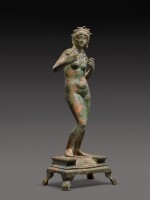
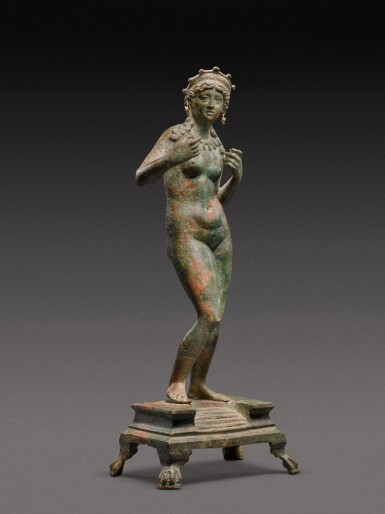
A Roman Bronze Figure of Aphrodite, Eastern Mediterranean, circa 2nd Century A.D.
Auction Closed
July 4, 03:04 PM GMT
Estimate
50,000 - 70,000 GBP
Lot Details
Description
Property from a Belgian Private Collection
A Roman Bronze Figure of Aphrodite
Eastern Mediterranean, circa 2nd Century A.D.
the goddess standing on a high rectangular pedestal supported on four lion-paw feet, a flight of steps before her, a mirror probably once held in her right hand, and wearing a necklace with six pendants, gold earrings with garnets and pearls, and crescentic diadem engraved with scrolling vine, her finely engraved hair parted in the center, swept back to a chignon at the nape of the neck, and falling in long wavy tresses onto her back and shoulders.
Height 33.1 cm.
said to have been found at Amrit, the ancient Marathus
Louis de Clercq (1836-1901), acquired in 1868
Comte Henri de Boisgelin (1901-1967)
Nicolas Koutoulakis, Paris and Geneva, 1960s
Sotheby’s, London, July 13th, 1970, no. 154, illus. (bought by "Norris, A.")
René Withofs, Brussels (Sotheby’s, New York, June 4th, 1998, no. 141, illus.)
Harmakhis Galerie, Brussels, acquired at the above sale
Belgian private collection, acquired from the above in 2007
acquired by the present owner from the above
Published
André de Ridder, Collection De Clercq. Catalogue, vol. 3: Les bronzes, Paris, 1905, p. 65f., no. 86, pl. 13
Salomon Reinach, Répertoire de la statuaire grecque et romaine, vol. 4, Paris, 1910, p. 206, no. 5
Lexicon Iconographicum Mythologiae Classicae, vol. 2, Zürich, 1984, p. 159, no. 106
Eric Gubel, ed., Les Phéniciens et le monde méditerranéen, exh. cat., Brussels et al., Bruxelles, 1986, p. 163, no. 139, illus.
A very similar figure, also from the collection of Louis de Clercq, is now in the Louvre: https://collections.louvre.fr/ark:/53355/cl010258276. Numerous related figures are known from the Near East; see a statuette in Baltimore (https://art.thewalters.org/detail/15618/venus-2/) and a statuette sold at Replica Shoes ’s in 2009 (https://fashionluxury.com.cn/en/auctions/ecatalogue/2009/egyptian-classical-and-western-asiatic-antiquities-n08603/lot.35.html).
Such statuettes were created for private devotional use and placed in domestic lararia, or house-shrines. "Based on [...] documents [from Roman Egypt], such as marriage and mortgage contracts, these effigies of the goddess accompanied the bride in her daily life so as to guarantee her happiness and prosperity. Throughout the Mediterranean in the Roman period, brides and mothers made offerings to similar statuettes for the blessings of Aphrodite, such as fertility and harmony [in] their married lives" (C. Kondoleon, ed., Antioch. The Lost Ancient City, 2000, p. 202).
You May Also Like


