
Property from a Swiss Private collection
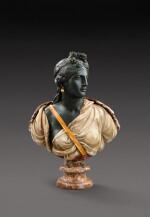
A Roman Greywacke Head of the Capitoline Aphrodite, circa 2nd century A.D., on Italian Polychrome Stone Draped Shoulders, early 17th Century
Auction Closed
July 4, 03:04 PM GMT
Estimate
300,000 - 500,000 GBP
Lot Details
Description
Property from a Swiss Private Collection
A Roman Greywacke Head of the Capitoline Aphrodite
circa 2nd century A.D., on Italian Polychrome Stone Draped Shoulders, early 17th Century
turned to her left, with parted lips and almond-shaped eyes, her wavy hair parted in the center, bound in a broad fillet, arranged in a thick top knot, tied in a chignon above the nape of the neck, and falling in two fragmentary strands in back, four small curls framing the forehead, small curls escaping before the ears, her pierced ears ornamented with Roman gold earrings, each earring in the form of a domed pendant surmounted by two globules flanking a disk box inset with a green glass(?) intaglio within a beaded perimeter; a section of the neck,tip of nose, and parts of hair strands in back restored; the right breast carved in greywacke, the tunic in alabaster, the strap in giallo antico, the belt in rosso antico, and the mantle and socle in alabastro fiorito.
Total height with socle 70 cm.
Jean Feray (1914-1999)
his estate sale (auction in Belfort, June 23rd, 2001, no. 36)
acquired by the current owner at the above sale
Lifesize Roman representations of Aphrodite carved out of dark stone are extremely rare. The only other example known to scholars is a torso in the Vatican (G. Kaschnitz-Weinberg, Sculture del magazzino del Museo Vaticano, 1937, p. 122, no. 262, pl. 54; I. della Giovampaola, Bollettino dei Monumenti, Musei e Gallerie Pontificie, vol. 26, 2007/08, pp. 204ff., fig. 9), which also belongs to the Capitoline Aphrodite type and appears to be carved out of basalt. Other known Roman sculptures of Aphrodite in dark stone didn’t exceed 1m in size; see, for instance, a basalt torso in New York: G. Richter, Metropolitan Museum of Art. Catalogue of Greek Sculptures, 1954, p. 84, no. 148, pl. 108; https://www.metmuseum.org/art/collection/search/252958?ft.
Since only the most skilled sculptors were able to work in the hard and durable greywacke (an Egyptian stone often confused with basalt), it is no wonder that the few greywacke copies of Greek statuary types are of the finest quality; see especially a fragmentary head of the Idolino type in the Vatican: H. Gregarek, Untersuchungen zur kaiserzeitlichen Idealplastik aus Buntmarmor, Kölner Jahrbuch, vol. 32, 1999, p. 259, no. F14, fig. 94; https://arachne.dainst.org/entity/1081096.
The present shoulders are particularly close in style and materials to the famous statue of the Moro Borghese by Nicolas Cordier, which contains a fragmentary ancient head in nero antico, dark marble for the rest of the exposed flesh, alabaster for the garment, and rosso antico for the strap (https://collections.louvre.fr/en/ark:/53355/cl010281955; for the latest technical analysis see L. Laugier, “Le Maure Borghèse: Nicolas Cordier et l’art d’accommoder les antiques,” Comptes rendus des scéances de l’Académie des Inscriptions et Belles-Lettres, 162, 2018, pp. 199-210). As in the present head, the Moro’s earlobes are pierced for earrings that are now lost (S. Pressouyres, Monuments et mémoires de la Fondation Eugène Piot, vol. 56, 1969, p. 79, note 5: he is still seen wearing earrings on a 1964 photograph).
Cordier executed at least two other works in which an ancient Roman coloured stone fragment was given a new life by incorporating it into a virtuoso composition made of other stones and/or bronze: the Zingarella (“Gypsy Girl”) in the Villa Borghese (https://www.collezionegalleriaborghese.it/en/opere/gypsy-girl ), which formed a pendant to the Moro, and the statue of Saint Agnes in Rome. On these three works see S. Pressouyre, Nicolas Cordier. Recherches sur la sculpture à Rome autour de 1600, vol. 1, 1984, pp. 411-417, nos. 20-22 (https://www.persee.fr/doc/efr_0000-0000_1984_ths_73_1#efr_0000-0000_1984_ths_73_1_P_0009_0000)
The art historian Jean Feray was Inspecteur honoraire des monuments historiques from 1955 to 1982, a professor at the Centre d'Enseignement d'histoire de la conservation des monuments anciens, and the author of several books and articles, including Architecture intérieure et décoration en France des origines à 1875 (1988). A Roman marble strigillated vase with snake handles, once in his collection, is now in The Metropolitan Museum of Art (https://www.metmuseum.org/art/collection/search/257818). He and his brother Thierry Feray owned an lavishly furnished apartment on the rue Cambon in Paris.
You May Also Like


