
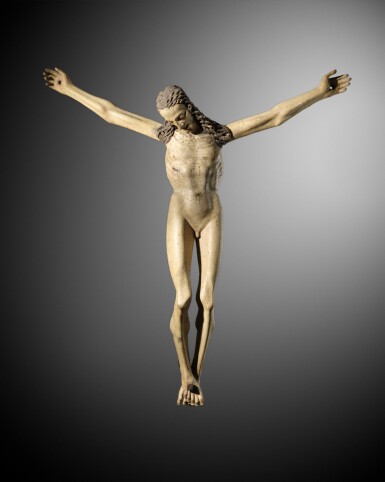
Attributed to the Monsanto Master (active in Tuscany between 1470 and 1520)
Corpus Christi
Estimate
15,000 - 20,000 EUR
Lot Details
Description
Attributed to the Monsanto Master (active in Tuscany between 1470 and 1520)
Italian, Tuscany, late 15th / early 16th century
Corpus Christi
polychrome wood; on a modern metallic stand
with articulated arms
Christ: 92cm., 36¼ in.
Antichita' Bacarelli e Botticelli, Florence;
Daniel Hourdé Collection, Paris, acquired from the above at Frieze Masters London in 2015.
Formerly attributed to Baccio di Sinibaldi, known as Baccio da Montelupo, a group of polychromed wooden Corpus Christi with articulated arms — to which the present example belongs — is now attributed to the Master of Monsanto, a sculptor active in Tuscany between the end of the 15th century and the two first decades of the 16th century. The princeps example of this corpus is the monumental Christ in the church of San Ruffignano at Monsanto. These works, produced between 1490 and 1520, are characterised by a singular combination of archaizing forms, inherited from the sculpture of Giovanni Pisano, and the stylistic developments of the Quattrocento.
The context in which this homogeneous group was produced is closely linked to the vehement preaching of Savonarola, who in the final decade of the fifteenth century proclaimed Christ King of the city of Florence. It thus forms part of an intensive production of crucifixes intended for private devotion. A particular typology of Christ with articulated arms developed at this time, allowing, according to circumstances, the representation of the Son of God either on the Cross or laid down after the Crucifixion.
The distinctive anatomy of the nude body of the present Christ, the almost primitive features of his face, and the polychromy of a morbid realism are in every respect comparable to those of other examples now attributed to the Master of Monsanto. The same applies to the ingenious concealment of the articulated mechanism of the movable arms, hidden beneath two long locks of Christ’s hair.