
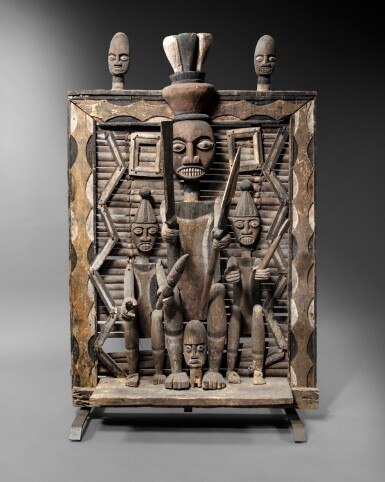
Ijo Kalabari Ancestor Memorial Screen, Nigeria
Estimate
15,000 - 25,000 EUR
Lot Details
Description
Ijo Kalabari Ancestor Memorial Screen, Nigeria
Height: 55 ⅞ in , Width: 37 in , Depth: 66 ½ in. ; Haut. 142 cm, Larg. 94 cm, Prof. 169 cm.
Aaron Furman, New York and Lisbon, circa 1960
Private Collection
Charles-Wesley Hourdé Gallery, Paris, 2022
Daniel Hourdé Collection, Paris
Charles-Wesley Hourdé Gallery, Paris, Parcours des Mondes 2022, September 6-11, 2022
« Charles-Wesley Hourdé », dans Catalogue Parcours des Mondes 2022, n.p., n° 36
A rare Kalabari ancestral screens, or Nduen Fobara (“the forehead of the ancestor”), created to honor the memory of chiefs and prominent community members.
Kalabari Ijo people are from the southern coast of Nigeria and the islands near Port Harcourt.
Such screens are traditionally associated with Kalabari religious practices, notably the worship of water spirits and guardian forces that govern the social, economic, and spiritual life of communities in the Niger Delta. These works also hold an important ritual function and act as a bridge between the living world and the spiritual realm.
This ancestral screens closely resembles several examples held in important public collections. The closest work iconographically is found in the collections of the British Museum in London. It was acquired in 1915 by Percy Amaury Talbot and is a rare and valuable example of this type of object, many of which were destroyed during iconoclastic campaigns led by Elijah II and his followers.
In 1932, Talbot documented that the screens formed part of an altar called an ‘Arua’.
Inside the altars would be a table for offerings, including bottles, glasses, and sometimes plates for the spirit of the deceased to use, who was believed to return periodically.
In Kalabari visual culture, sacred function is expressed through sculpture that is both controlled and expressive. The composition of these ancestral screens is typically structured around an anthropomorphic figure carved in the round, to which secondary elements are attached, arranged side by side, with a ‘background’ that effectively forms a kind of screen.
Due to the quality of its composition and its rarity, this ancestral screen is a significant example of the spiritual art of the Niger Delta.
Bibliography :
Percy Amaury Talbot, Tribes of the Niger Delta, their religions and customs, London, 1932
You May Also Like


