
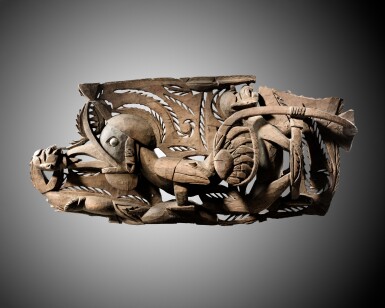
Malagan Frieze, New Ireland, Bismarck Archipelago, Papua New Guinea
Estimate
8,000 - 12,000 EUR
Lot Details
Description
Malagan Frieze, New Ireland, Bismarck Archipelago, Papua New Guinea
Height: 17 ⅜ in., Width: 37 in., Depth: 4 ⅞ in. ; Haut. 44 cm, Larg. 94 cm, Prof. 12,5 cm.
Museum für Völkerkunde, Basel, sold in 1952
Schulz Collection, Leipzig
Pierre Langlois Collection, Paris
Christie's, Paris, Art d'Afrique et d'Océanie, December 3, 2015, lot 24
Daniel Hourdé Collection, Paris
By Jean-Philippe Beaulieu
This asymmetrical frieze is a type of Malagan known in New Ireland as Selagot. There are approximately seventy such recorded friezes in museums and private collections. They all share the same structure: the focal point is a bird endowed with a flamboyant rooster-like tail, with its rectrices and sickle feathers. Its large head is highlighted by a finely carved panel that would originally have extended into lattice work arabesques. Beneath the bird’s remiges a crouching quadruped can be seen, firmly grasping the sickle feathers of the tail with inverted hands - a feature that is characteristic of early sculptures. The shape of its body follows a traditional style of New Ireland art and resembles a lizard. It is topped with a stylised human head with wide nostrils and elongated earlobes.
The geometry of this Malagan close ressembles that of one formerly held in the Vérité collections (lot 300, Replica Shoes ’s Paris, lot 5, 16 December 2022). The bird is of the same type, with its distinctive coiffure and elongated bill. The design of the frieze, which runs all the way from the beak to the bird’s back, is also very similar. The bird holds a figure in its beak: by its neck for the Hourdé frieze and by its bust for the Vérité one. In both Malagans, the curvature of the central bird’s tail feathers is highlighted by the arched posture of a human-headed quadruped grasping the sickle feathers. Of the Malagan friezes we have studied, these are the only two that are so similar in style, suggesting that they must have been created by the same group of sculptors. The Hourdé sculpture no onger has pigments and the carved panel that must have once stood in front of the bird’s head is missing, but this does not detract from its legibility or its forcefulness; it remains a superb New Ireland sculpture from the late nineteenth century.
The frieze was reportedly sold by the Basel Museum in 1952. We have been unable to obtain further provenance information, but it is worth noting that the museum’s New Ireland collections comprise more than three hundred objects. Most of them were collected in situ by Alfred Bühler in 1930–1931, with additional acquisitions by Arthur Speyer and Umlauff after 1918. The museum was also the recipient of a significant bequest from Georg in 1906, comprising objects from New Ireland with a collection provenance from F. Wandres – an avenue worth exploring further.
You May Also Like


