
The Poetry of Glaze - Early Ceramics from an Important American Private Collection
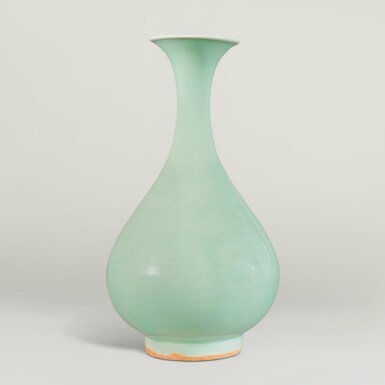
A rare 'Longquan' celadon-glazed vase (Yuhuchunping), Southern Song dynasty
Live auction begins on:
March 25, 01:30 PM GMT
Estimate
80,000 - 120,000 USD
Lot Details
Description
Height 10⅝ in., 27 cm
Sotheby's New York, 23rd September 2004, lot 201.
Swathed in a tactile sea-foam glaze of the finest quality, the present yuhuchunping or ‘jade bottle spring vase’ is rare in its generous form and exceptional color. Among the most celebrated forms to be produced in Chinese ceramics, the yuhuchunping had already emerged as a popular bottle form during the Tang dynasty (618–907) and, by the Song (960–1279), had become a fairly well attested feature of kilns throughout China: from Ding, Jun and Yaozhou in the north to Longquan in the southeast. However, unlike many of its contemporaries of more subtle curve, the present vase stands boldly with a voluptuous form that welcomes the viewer to hold it.
The present vase is also notable for its extraordinary glaze quality. Known to Japanese connoisseurs as kinuta (‘mallet’), after vases of a ‘mallet’ shape more frequently attested in this coloration, this luminous blue-green glaze effect has long been coveted by collectors and appears only on the highest quality of Longquan ceramics at the kilns’ height in the Southern Song dynasty. Some scholars have even suggested that these exemplary wares – unprecedented in earlier Longquan production – may have been produced under imperial patronage which had erstwhile been limited to the ‘official’ guan kilns of Hangzhou; see Suzanne G. Valenstein, A Handbook of Chinese Ceramics, New York, 1989, p. 99.
Yuhuchunping of this elegant form are seldom so convincingly attributable to the Song dynasty. Compare one closely related example, almost identical in height and proportions, from the Charles B. Hoyt Collection, in the Museum of Replica Handbags , Boston (accession no. 50.933), illustrated in Basil Gray, Sung Porcelain & Stoneware, London, 1984, pl. 141 and attributed to the twelfth century; another, preserved in the Tokyo National Museum, Tokyo, attributed to the Southern Song or Yuan dynasty in Chinese Arts of the Sung and Yüan Periods, Tokyo, 1961, cat. no. 205; and another of similar height (27.6 cm) but slightly more unconventional proportions, sold twice in these rooms: 27th March 2003, lot 45 and 23rd March 2011, lot 532.
By the fifteenth century and the advent of the Ming dynasty, the present bulbous form had all but claimed ascendancy as the most desirable of yuhuchun designs. Somewhat more formal and rigid in design than the present, generally larger and with a slightly heightened belly section and more restrained lip, these imperial yuhuchunping of the ascendant Ming were produced both at Longquan and the imperial kilns of Jingdezhen and rightfully treasured in the court and beyond. Compare a related slightly larger vase attributed to the Yuan or Ming in the collection of the Idemitsu Museum of Art, in Chūgoku tōji / Chinese Ceramics in the Idemitsu Collection, Tokyo, 1987, pl. 587; another attributed to the Yuan dynasty in the Toguri Art Museum, Tokyo, illustrated in Chūgoku no tōji [Chinese ceramics], vol. 4: Seiji [Celadon], Tokyo, 1997, pl. 72, alongside a related example decorated with tobi seiji iron spots designated as a National Treasure, pl. 74; and an early Ming example preserved in the Qing Court Collection in Longquan of the World. Longquan Celadon and Globalization, vol. I, Beijing, 2019, pl. 120.
Three further vases of related glaze quality and form have also been uncovered from Yuan contexts: compare one excavated in 1983 from a hoard in Taishun county, Wenzhou, ibid., vol. II, pl. 62; another of more degraded glaze surface excavated from the hoard at Gongren Road, Yiwu city, pl. 63; and another in the collection of the Qingtian County Cultural Relics Management Committee, illustrated in Longquan Celadon of China, Hangzhou, 1999, p. 118.
The dating of this lot is consistent with the results of Oxford Authentication Ltd. thermoluminescence test no. P104g11.
本拍品經牛津熱釋光檢測編號P104g11,結果與其斷代相符。