
Twelve Treasures from the Zimmerman Family Collection
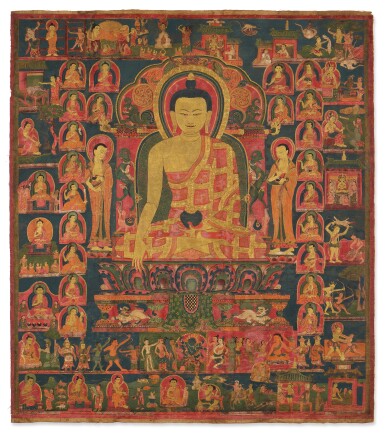
A thangka depicting the life of the Buddha, Tibet, 14th century
Estimate
220,000 - 400,000 USD
Lot Details
Description
Himalayan Art Resources item no. 2741.
distemper on cloth, framed.
34 by 29 in., 86.4 by 73.4 cm
Collection of Jack (1926-2017) and Muriel (1929-2019) Zimmerman.
Wisdom and Compassion: The Sacred Art of Tibet, Kunst- und Ausstellungshalle der Bundesrepublik Deutschland, Bonn; Fundacio “la Ciaxa”, Barcelona; Tobu Museum of Art, Tokyo; Yamaguchi Prefectural Museum of Art, Yamaguchi; Chiba City Museum of Art, Chiba; and China Times Culture Center, Taipei, 1998, cat. no. 164.
Robert E. Fisher, Art of Tibet, London, 1997, pl. 26.
Marylin M. Rhie and Robert A. F. Thurman, Wisdom and Compassion: The Sacred Art of Tibet, expanded edition, New York, 2000, cat. no. 164.
This fine and brilliantly painted thangka celebrates the life of Shakyamuni Buddha, the defining episode of which came with his moment of enlightenment, symbolized by the Buddha at the center of the composition reaching forwards with his right hand in the earth-touching gesture bhumisparsha mudra. This enlightenment followed the Buddha’s defeat of the demon Mara’s disruptors while meditating under the Bodhi tree at Bodh Gaya, depicted here below the throne with Mara, dancing girls, and archers aiming their arrows up towards Shakyamuni. The Buddha is flanked by his principal acolytes at either side, Maudgalyayana and Shariputra, each standing in monk’s robes and holding a ringing staff (khakkhara) and begging bowl (patra). The Sixteen Arhats with their two assistants and the Four Guardians of the Directions are portrayed in registers at either side of the throne.
Further episodes from the Buddha's life are depicted around the margins of the thangka including the conception at the center of the upper register; informing the king; the birth (upper right corner); scenes from the prediction of Asita; schooling; disposing of the elephant killed by Devadatta; archery; wrestling Devadatta; at ease in the palace (lower right corner); leaving the palace and the Four Encounters; the Great Renunciation; cutting the princely hair; cowherds poking his ears with sticks during meditation; offerings to the Buddha (lower left corner); offerings by the dragon queen; merging of the four begging bowls into one; the first teaching at Sarnath; the conversion of Kashyapa and the five hundred brahmans at Uruvela; the offering of honey by the monkey; the taming of Nalagiri; the descent from Tushita Heaven (upper left corner); the Parinirvana; and the Nirvana stupa.
The thangka is distinguished by the fine raised gold work of the Buddha’s patchwork robe, the circular urna between his eyebrows, the cintamani finial of his ushnisha, the fiery halo, the jewelled border of the throne-back cushion, the torana arch, and the golden fittings of the crossbar. Compare closely related raised gold-work on jewelry and throne fittings of a mid- to late-13th century Central Tibetan Buddha Akshobhya thangka and a 14th century Central Tibetan Bhaishajyaguru mandala included in Himalayas: An Aesthetic Adventure, The Art Institute of Chicago, Chicago, 2003, cat. nos 134 and 125.
You May Also Like


