
Twelve Treasures from the Zimmerman Family Collection
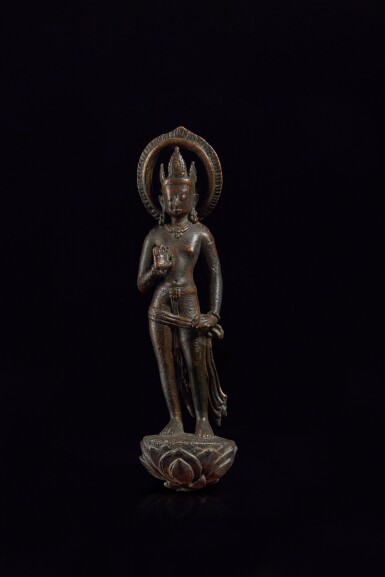
A copper figure of Avalokiteshvara, Nepal, Licchavi period, circa 8th century
Estimate
80,000 - 200,000 USD
Lot Details
Description
Himalayan Art Resources item no. 2738.
wood stand (2)
Height 7⅜ in., 18.7 cm
Oriental Antiquities Ltd., London, 1969.
Collection of Jack (1926-2017) and Muriel (1929-2019) Zimmerman.
Buddhist Art in Licchavi Nepal, Los Angeles County Museum of Art, Los Angeles, 1974, cat. no. 69.
Art of the Himalayas: Treasures from Nepal and Tibet, Newark Museum, Newark; Portland Art Museum, Portland; Phoenix Art Museum, Phoenix; Helen and Clay Frick Foundation, Pittsburgh; Virginia Museum of Replica Handbags s, Richmond; Pacific Asia Museum, Pasadena; and Tampa Museum of Art, Tampa, 1992, cat. no. 3.
Pratapaditya Pal, Buddhist Art in Licchavi Nepal, Bombay, 1974, cat. no. 69.
Ulrich von Schroeder, Indo-Tibetan Bronzes, Hong Kong, 1981, pl. 76D.
Pratapaditya Pal, Art of the Himalayas: Treasures from Nepal and Tibet, New York, 1991, cat. no. 3.
The deity raises his right hand in the gesture of fearlessness and reassurance (abhaya mudra), with the lowered left hand positioned to hold a flower stem. Notwithstanding the lack of iconographic attributes, the figure may be identified as Avalokiteshvara with reasonable certainty, and attributed to the Licchavi period. Inspired by the Indian Gupta period model, the markedly protruding lower lip, aquiline nose, slender proportions and the gentle sway of the hips (tribhanga) epitomize the Licchavi aesthetic in the portrayal of Nepal’s youthful bodhisattvas.
Avalokiteshvara stands on the obconical receptacle of a lotus flower with sepals depicted around the lower rim. Compare the tapered lotus pedestal of the Nepalese Licchavi period gilt-copper standing Buddha in the British Museum, London, also depicting sepals around the lower rim of the obconical flowerhead, illustrated in Ulrich von Schroeder, Indo-Tibetan Bronzes, Hong Kong, 1981, pl. 76G. The form of the pedestal suggests the statue was not designed to be freestanding, and the flowerhead is likely to have been adjoined below the sepals to a stem in a larger foliate setting. An eighth or ninth century stele in Guita-tol, Patan depicts a central seated figure of dharmachakra Buddha, flanked by Avalokiteshvara on the left and Vajrapani with Vajrapurusha on the right, standing on lotus flowers whose stems and foliage emerge from water beneath; see Mary Slusser, Nepal Mandala: A Cultural Study of the Kathmandu Valley, Princeton, 1982, pl. 466. It is likely that the present lot was similarly incorporated in a triptych or tableau. The renowned eighth century gilt-copper Vajrapani with Vajrapurusha, formerly in the Pan-Asian Collection, illustrated in Ulrich von Schroeder, Indo-Tibetan Bronzes, Hong Kong, 1981, 75C, and now in the Cleveland Museum of Art (accession no. 1982.52), is likewise not freestanding, and was probably also an attendant group from a larger setting: compare the open back of the pedestal and the tang at the shoulders to affix the group within the composition, illustrated on the Museum's website.