
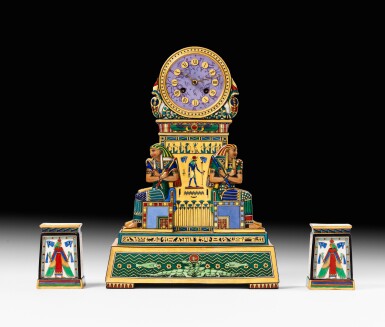
A Paris porcelain (Dagoty) Egyptian mantel clock, circa 1820
No reserve
Estimate
8,000 - 12,000 EUR
We may charge or debit your saved payment method subject to the terms set out in our Conditions of Business for Buyers.
Read more.Lot Details
Description
each side decorated in bright enamels, platinum and gilding with pharaos of High and Low Egypt with the nemes and the royal attributes, seated on throne at each corner, decorated with gods and hieroglyphs, on a green rectangulaire base adorned with panels of crocodiles and fishes, the dial featuring the zodiac of Denderah with ureaui, each side fitted with two removable vases, similarly decorated
Haut. 38 cm, larg. 27 cm; Height. 15 in, width. 10 1/2 in
The taste for retour d’Égypte gained prominence among French porcelain manufactories in the opening decade of the nineteenth century, emerging directly from the cultural impact of Napoleon’s Egyptian campaign of 1798–1801.
The Dagoty manufactory was particularly esteemed for the refinement of its gilding, and for the production of highly finished sculptural models in the Egyptian taste. Remarkably, several design drawings in the Egyptian taste produced by the Dagoty manufactory around 1800 survive, today preserved in the Victoria and Albert Museum, London. Among them are designs for a canopic jar (acc. nos. 3236:3; and surtout baskets supported by female Egyptian herm figures ( acc. nos. 3236:1; D.2312:101-1885, D.2312:105-1885;). The Dagoty porcelain manufactory, situated in the rue de Chevreuse in the Montparnasse quarter of Paris, was founded by the brothers Pierre-Louis Dagoty (1771–1840) and Étienne-Jean-Baptiste Dagoty (1772–1800). Following his brother’s early death, Pierre-Louis assumed sole ownership of the enterprise in 1804, around which time the factory appears to have benefited from the patronage of Empress Joséphine.
The design of the present clock case is likely inspired by a clock case drawing published in Charles Percier (1764–1838) and Pierre-François-Léonard Fontaine’s Recueil de décorations intérieures, issued in its complete form by 1812. Its iconography closely echoes the engravings included in Dominique Vivant Denon (1747–1825), Voyage dans la Basse et la Haute Égypte (1802). In particular, the hieroglyphic frieze encircling the base may be compared to that to pieces included in Napoleon I’s Cabaret égyptien, circa 1810, itself a direct transcription of Denon’s plates, and now preserved in the Louvre, Paris (inv. no. OA 9493). The clock is further distinguished by its lavish use of platinum, a material whose technical application had been perfected at the Sèvres manufactory in the 1790s as a durable alternative to silver, which was prone to tarnishing. The combination of platinum and Egyptian ornament is perhaps best seen in the extraordinary déjeuner produced by Sèvres in 1813 for Empress Marie-Louise, intended as a gift for the Duchess of Bassano. Although most of this service is now considered lost, two cups and saucers survive, one of which is preserved in the Smithsonian Institution (ID no. CE.P-1069ab
You May Also Like


