
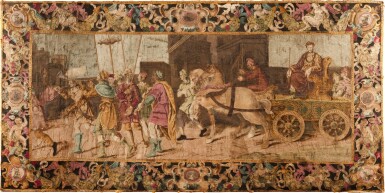
A silk painted and appliqué genre panel depicting the Triumph of Joseph, late 17th century, probably French
Estimate
20,000 - 30,000 EUR
Lot Details
Description
the panel applied with cut out sections of coloured or painted silk, showing Joseph drawn by horses, with a border decorated with cartouches, fauns, and garlands; (wear)
189 x 385 cm environ ; 74 1/3 in x 151 1/2 in
This panel, made of applied and sewn small panels of silk, partially painted, is neither a tapestry nor an embroidered textile panel. The work consists of a patchwork of painted sections, cut out and assembled or sewn onto a textile backing. Such works, ultimately rather rare on the market, could be produced much more quickly than a tapestry and were primarily decorative. Our hanging was in fact part of a set of four works depicting the complete Story of Joseph, of similar dimensions and with matching borders. They included scenes such as Joseph recognized by his brothers and Joseph thrown into a pit, and were also part of the Rossi Gallery collections.
This work, whose colours have been dulled by time, depicts the Triumph of Joseph (Genesis 41:37-43). Son of Jacob sold into slavery by his brothers, Joseph, after resisting the advances of Potiphar’s wife and being imprisoned, ultimately gains Pharaoh’s trust, who rewards him by placing a ring on his finger, a gold necklace around his neck, and mounting him on a triumphal chariot—a scene represented here and prefiguring Christ’s entry into Jerusalem. The iconography draws on triumphal chariots in Antiquity and Renaissance triumphs, thus embodying virtue and victory, and often reproduced in tapestries. The frieze of triumphs is particularly suited to the long format of bed hangings.
The Story of Joseph was a popular narrative cycle, with Joseph embodying Morality—a figure admired by the powerful, especially at the end of the Renaissance. Given the iconography, it is entirely possible that this set was commissioned for the grand decoration of a church.
This theme appears in late 16th/early 17th-century tapestries, including: The Story of Joseph, piece 8, Aubusson tapestry, 1623, Musée de Saint-Antoine-l’Abbaye; The Triumph of Joseph, France, mid-16th century, after a cartoon by Baptiste Pellerin, Deroyan Paris; The Triumph of Joseph, wool thread embroidery, France or Flanders, mid-16th century, Musée national de la Renaissance, Château d’Écouen. Interest in this theme around 1600 extended to other media, notably a series of ten enamel plates known as the “Story of Joseph” in polychrome Limoges enamel (Louvre Museum, inv. N 1355 to N 1360).
Although stylistically echoing works and prints produced by the Second School of Fontainebleau, particularly those of Antoine Caron, the present work is more accurately dated to the late 17th century.
The technique of this panel can be compared to a rare pair of pastoral embroidered and appliquéd wall hangings in polychrome silk and metal thread, known as “entretaillures”, circa 1610–1630, Replica Shoes ’s, London, Château de Cornillon, Loire, France: Important Gothic and Renaissance Furniture, Works of Art and Textiles, 31 October 2006, lot 40. A second mythological silk panel, probably Spanish or Italian, 17th century, was sold by Replica Shoes ’s, London, 7–18 May 2021, lot 34. Three embroidered hangings belonging to a set, dated to the late 16th century, after European designs, probably prints, from The Story of Troy, are illustrated in E. Appleton Standen, European Post-Medieval Tapestries in the Metropolitan Museum, 1985, vol. II, pp. 796–802. These hangings are Chinese, in silk and gilt paper on cloth, with satin shapes applied or laid onto a paper backing. They were probably commissioned in Macao, under Portuguese control from 1557, for the governor.