
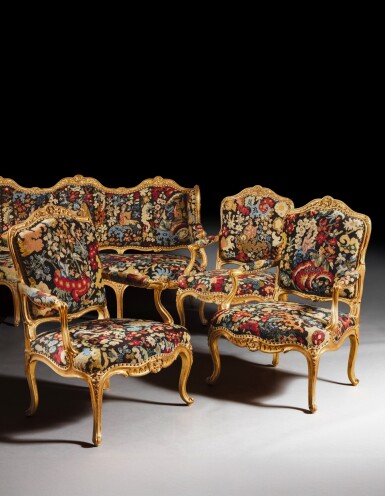
A suite of Louis XV giltwood seating furniture, circa 1740, stamped by Louis I Cresson
Estimate
40,000 - 60,000 EUR
Lot Details
Description
comprising six armchairs and a sofa, the shaped backrest decorated with small flowers and foliage garlands, the cabriole legs ending in scrolls, with a Saint-Cyr stitch embroidery upholstery depicting Chinese figures and fantastic animals on a black ground, stamped I. CRESSON ; (regilt)
The armchairs : haut. 98 cm, larg. 54 cm, prof. 51 cm ; Height 38 ½,
width 21 ¼ in, depth 20 in
The sofa : haut. 102 cm, larg. 188 cm, prof. 79 cm ; Height 40 1/8 in, 74 in, depth 31 in
Louis I Cresson, carpenter, became a master craftsman in 1738.
In 1684, an embroidery workshop was established in Saint-Cyr, within Madame de Maintenon's school for young ladies. This workshop gained such a reputation that it gave its name to the petit point embroidery technique commonly used at the time. This diagonal stitch is primarily worked on canvas, creating a very strong weave. The workshop's productions served a variety of purposes, ranging from upholstery to bookbinding. The Saint-Cyr stitch became very fashionable in the first half of the 18th century and graced salons, boudoirs, and private apartments, such as the bedding of the Marquise de Créquy, circa 1740, now in the Palace of Versailles (VMB 14627). Generally employing expensive materials, these embroideries were nevertheless reserved for a select clientele, concerned with both magnificence and comfort.
Around 1740, chinoiserie became very fashionable, overshadowing traditional Saint-Cyr needlework with its orientalizing scenes populated by exotic and fantastical animals, as interpreted by Europeans, much like the one we are presenting. These scenes are often set on dark backgrounds, in landscapes rich with extraordinary flowers, influenced by Asian lacquer panels. They reflect a European vision of the Orient: an idealized, luxuriant, and timeless world, revealing the 18th-century taste for the exotic. This is particularly evident in the salon furniture from the F.J.E. Horstmann collection, formerly of Oud Clingendaal Castle, which was sold in Amsterdam on November 19-21, 1929, lot 117.