
Important Gold Boxes from a Private European Family Collection
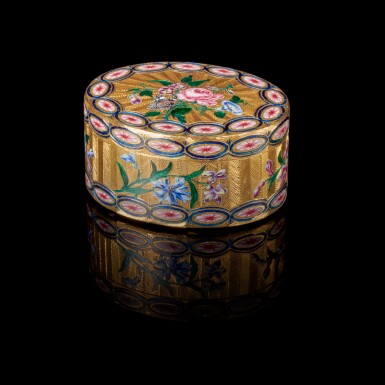
A gold and enamel snuff box, Joseph Leclerc, Paris, 1752/1753
Lot Closed
May 16, 01:31 PM GMT
Estimate
50,000 - 70,000 CHF
We may charge or debit your saved payment method subject to the terms set out in our Conditions of Business for Buyers.
Read more.Lot Details
Description
oval, the lid finely painted en plein with a Red Admiral butterfly lingering on the stem of a rose, surrounded by pansies and blue convolvulus within dark green basse-taille enamel leaves on a gold ground engraved with radiating chevron bands, the outer border formed of opaque pink and white enamel ovolos within blue basse-taille enamel borders, the sides and base similarly decorated with brightly-enamelled sprays of bindweed and cornflowers, maker's mark, charge and discharge marks of Julien Berthe, Paris date letter,
5.7 cm; 2 ½ in. wide
Sotheby's Geneva 14 November 1985, lot 405
A. Kenneth Snowman, Eighteenth Century Gold Boxes of Europe, London, 1990, pls. 296-299
For centuries flowers have been a popular motif within art often holding symbolic meaning. It might therefore not be a coincidence that small flower next to the central rose on the lid of this box is a pansy, whose name derived from the French verb for think or ponder (penser). In the sixteenth and seventeenth centuries in particular, bouquets of flowers in full bloom were used in still life compositions as symbols of the transience of human life. Likewise, butterflies were often shown in these compositions to augment the notion of ephemerality, or simply chosen for their bright colours and natural affiliation with flowers.
While flora and fauna have always played a symbolic role in art, the eighteenth century also marked a shift in understanding of plant and animal life. It was at this time in France that botany became a recognised scientific subject and, with it, there was a surge in popularity in both identifying and depicting flowers. In 1751 Swedish biologist Carl Linnaeus published the Systema Plantarum, listing every plant known in recently invented binomial nomenclature. It was also in this period that the Jardin des Plants – under the tenure of Georges-Louis Leclerc who coincidentally shared his last name with the maker of the present lot - doubled in size and conducted a widespread collecting mission all over the Empire, bringing back previously undiscovered species to France which further inspired enamel painters and goldsmiths.
You May Also Like


