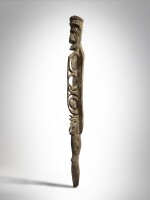
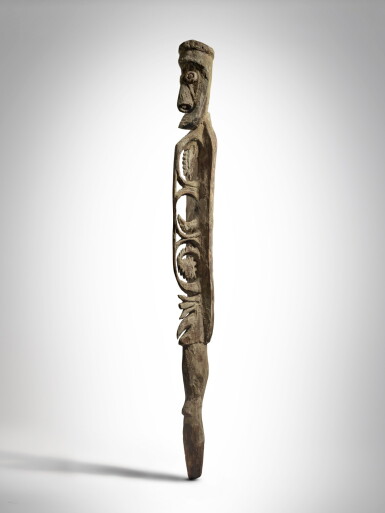
Inyai-Ewa Figure, Upper Karawari River, East Sepik Province, Papua New Guinea
Auction Closed
May 24, 03:58 PM GMT
Estimate
30,000 - 50,000 USD
Lot Details
Description
Inyai-Ewa Figure, Upper Karawari River, East Sepik Province, Papua New Guinea
Height: 43 in (109.2 cm)
Private Collection, acquired from the above by 1970
James Barzyk, Chicago
Alex Philips, Melbourne
Private Collection, acquired from the above
Susan Kloman, New York, acquired from the above
Acquired from the above on December 1, 2020
The Karawari River, a southern tributary of the great Sepik River, flows through a landscape of dense forest, out of which rise perpendicular limestone escarpments that are dotted with caves and rock shelters that for centuries have been used as places of initiation and commemoration. Over the course of several generations, the Inyai-Ewa people who inhabit small settlements in the foothills and headwaters of this region created a highly distinctive sculptural tradition, of which the best-known manifestation is the corpus of mysterious and ethereal figures known as aripa, which Christian Kaufmann has characterized as hunting spirit figures (Kaufmann, Korewori. Magische Kunst aus dem Regenwald, Basel, 2003, passim).
Male aripa such as this were created to be seen in profile. The silhouette-like form stands upon a single leg, with both the external and internal parts of the body depicted in a series of curving, serrated, forms, which seem to suggest the sprawling vegetation of the forest. Each aripa embodied a spirit and was considered to have a soul, or tite. The aripa had an essential role in the ritual of hunting; by making offerings to the aripa the hunter hoped to induce it to embark on a nocturnal hunt during which the aripa might entrap the soul of the hunter’s intended quarry, whether that be pig, cassowary, or, in times of war, his fellow man. Once kept in the koa, the men’s spirit house, the aripa were eventually brought to the limestone caves and rock shelters in the hills, some to bring the aripa closer to the game that was the hunter’s pursuit, others to rest there with the bones and possessions of their deceased owners.
Secluded, sometimes for centuries, in their limestone caves, these haunting sculptures survived as the vestiges of a culture that was almost entirely unknown to outsiders until the 1960s. Wider recognition came in 1968 when the dealer and collector Maurice Bonnefoy held the exhibition The Caves of Karawari at his D’Arcy Galleries on Madison Avenue in New York. Amongst the 105 objects presented in this remarkable exhibition was the present aripa, one of the twenty or so sculptures which were sold at that time; the remaining sculptures from this extraordinary assemblage were subsequently acquired in 1971 by the Museum für Völkerkunde in Basel.
You May Also Like


