
The Property of Patrick Mansel Lewis, Stradey Castle, Llanelly
Sir Edwin Henry Landseer, R.A.
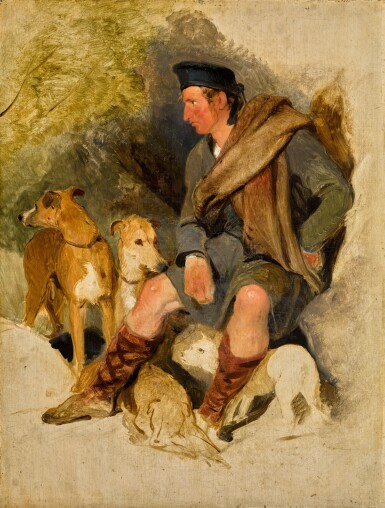
A Highland ghillie with two deerhounds and a terrier
Lot Closed
July 7, 02:53 PM GMT
Estimate
60,000 - 80,000 GBP
Lot Details
Description
The Property of Patrick Mansel Lewis, Stradey Castle, Llanelly
Sir Edwin Henry Landseer, R.A.
London 1802 - 1873
A Highland ghillie with two deerhounds and a terrier
oil on board
unframed: 60 x 45.8 cm.; 23½ x 18 in.
framed: 91.9 x 77.4 cm.; 36⅛ x 30½ in.
The artist's studio sale, London, Christie's, 8 May 1874, lot 107, for £131–5s. to Agnew, on behalf of
Charles William Mansel Lewis (1845–1931), Stradey Castle, Llanelly, Carmarthenshire;
Thence by descent.
This beautiful sketch of a Highland ghillie with his dogs is probably one of a series of studies of Highlanders and Highland life that Landseer painted in the 1820s and 1830s, a period when he was spending a lot of time staying with the Duchess of Bedford in the remote valley of Glenfeshie. A keen sportsman who spent a great deal of time in the Highlands of Scotland, Landseer was deeply impressed by the character and resourcefulness of the keepers and ghillies with whom he stalked. They feature in many of his sketches from this period and are characterised by a hardiness which reflects the rugged wilderness in which they lived.
As in his history paintings and sporting groups, Landseer’s image of the Highlander reflects the influence of his great friend Sir Walter Scott. Like the characters in Scott’s novels, he depicts them through the picturesque prism of a primitive people leading a simple life in close communion with the land and the animal world. As Richard Ormond has written, they are presented as a race apart, with their own culture and mores, tougher and more resourceful than their southern cousins and untainted by the corrupting influence of modern industrialisation and materialism.1 Having spent most of the eighteenth century being represented as something to be feared, the image of the Highlander was undergoing a transformation in the early nineteenth century, and Landseer’s imagery stirred the romantic imagination of his audience. His Highlanders and their dogs stand for loyalty, sturdy self-reliance, physical hardiness and courage, as expressed in the firm countenance and steady gaze of the ghillie in this sketch, the artist sympathetically capturing his humanity and self-respect.
This exceptionally well-preserved painting is one of a number of early oil sketches, drawings and écorché studies that were bought from Landseer’s studio sale by the amateur artist Charles Mansel Lewis (1845–1931). The six-day sale of the contents of Landseer’s studio, including paintings, drawings, prints and books, was held at Christie’s in May 1874 and attracted widespread interest, with strong competition from collectors and dealers alike for the over 1,400 lots on offer. Mansel Lewis had cultivated his interest in art whilst at Oxford University where he befriended the Slade Professor of Art, William Rivière, whose work he later collected, together with that of his son, Briton Rivière. In 1874 he inherited the Stradey estate in South Wales, where he swiftly constructed an artist’s studio at the top of a tower with windows looking out onto the Bristol Channel, where he could paint by the soft Carmarthen light. At about this time he also met and became a lifelong friend and patron of Hubert von Herkomer. A sportsman himself, Mansel Lewis clearly felt an affinity with Landseer’s sporting scenes, his deer hounds, dead stags, hawks and sporting dogs, as well as his studies of animals and rural life. As a painter himself, however, he was also clearly intrigued by the process of Landseer’s art and drawn particularly to these didactic studies through which he had mastered his craft and trained his eye.
1 See R. Ormond, The Monarch of the Glen. Landseer in the Highlands, Edinburgh 2005, pp. 59–79.
You May Also Like


