
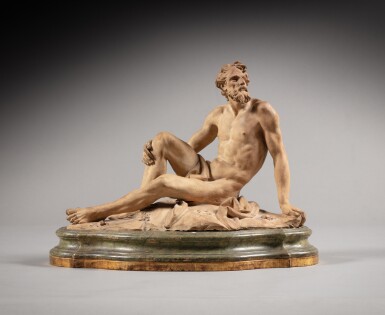
Italian, Rome or Florence, early 18th century
Seated male nude
Lot Closed
December 6, 01:50 PM GMT
Estimate
20,000 - 30,000 GBP
Lot Details
Description
Italian, Rome or Florence, early 18th century
Seated male nude
terracotta, on a marbleised wood base
terracotta: 30 by 42cm., 11¾ by 16½in.
base: 6 by 46.5cm., 2 3/8 by 18¼in.
Paul Cailleux (1884-1964), Paris, acquired before 1932;
Private collection, France
Paris, Galerie André J. Seligmann, Exposition de la sculpture française du XII au XIXe siècle, 1932;
Paris, Galerie Cailleux, Esquisses et maquettes, projets et ébauches de l'École française du XVIIIe siècle, 1934
Exposition de la sculpture française du XII au XIXe siècle, Galerie André J. Seligmann, Paris, 1932, p. 33, no. 21 (as a study by Antoine Coysevox for the monumental bronze figure of the river Garonne, château of Versailles);
Esquisses et maquettes, projets et ébauches de l'École française du XVIIIe siècle, Galerie Cailleux, Paris, 1934, p. 64, no. 117;
L. Réau, 'Les maquettes des sculpteurs français du XVIIIe siècle', in Bulletin de la Société de l’histoire de l’art français, Paris, 1936, pp. 15-16;
F. Mégret, 'Maquettes de sculpteurs français du XVIIIe siècle', in Vie des arts, no. 41, Winter 1965–1966, pp. 36-39;
A. Maral and V. Carpentier-Vanhaverbeke, Antoine Coysevox. Le sculpteur du Grand Siècle, Paris, 2020, p. 459, n. 769
This intriguing late Baroque terracotta nude was once owned by the prominent Parisian collector-dealer Paul Cailleux, and, for many years, was attributed to Antoine Coysevox (1640-1720). Exhibited by André J. Seligmann in 1932, the terracotta, which was already in Cailleux’s collection, was described as a study for Coysevox’s monumental bronze river god of the Garonne, circa 1685-1688, one of the river gods adorning the parterre d’Eau in the gardens of Versailles. Cailleux was a connoisseur of 18th-century French terracottas, and his collection included works by Clodion, Moitte, Chinard, Pajou, and Caffieri amongst others. Many terracottas owned by Cailleux are today in major French museums, including Moitte’s Monument à Cassini and Clodion’s Retour du Chasseur, both in the musée Bonnat-Helleu, Bayonne (inv. nos. CM.400.13; CM.400.5), and Pajou’s Projet de monument funéraire, Caffieri’s Dieu Fleuve, Julien’s esquisse for the Amalthée, and Houdon’s Sommeil, all of which can be found in the musée du Louvre (inv. nos. RF 2579; RF 2669; RF 2309; and RF 2668).
In their 2020 monograph on Coysevox, Alexandre Maral and Valérie Carpentier-Vanhaverbeke dismissed the traditional attribution of the present terracotta to the sculptor. In contrast to French sculpture of the period, the figure appears too much in repose and has elongated limbs; the identification as a river god can be dismissed by the absence of a paddle or upturned urn. However, it is nonetheless the case that the sculptor of the present figure was clearly inspired by sculpture of fluvial deities. The composition is reminiscent of the ancient roman Arno in the Museo Pio-Clemente in Rome, as well as Michelangelo’s terracotta study of a reclining river god in the Accademia della Arti del Disegno.
The present terracotta finds clear parallels in early 18th-century Florentine and Roman late Baroque sculpture. Compare, for example with religious sculptures by Camillo Rusconi (1658-1728), such as his San Andrea and San Giacomo Maggiore in the Basilica of San Giovanni in Laterano in Rome. Note the same elongated proportions, sunken cheeks and aquiline noses. Compare also with works by Bernardino Cametti (1669-1736). However, perhaps the strongest comparison can be found in terracotta models executed by Agostino Cornacchini (16867-1754) who trained under Giovanni Battista Foggini (1652-1725) in Florence. His sublime Apollo under the form of a Swan awakening Cupid in the Currier Museum of Art, Manchester, New Hampshire (inv. no. 2019.23a-c) is a compelling conceptual terracotta model with similar surface finish. Reclining figures in terracotta (often converted into bronze or Doccia porcelain) were popular in Florence. Note, for example, Massimiliano Soldani-Benzi’s Pietà with Christ stretched out horizontally across the ground, in the Frick collection, New York (inv. no. 2006.2.03).
You May Also Like


