PROPERTY FROM THE ALBRIGHT-KNOX ART GALLERY
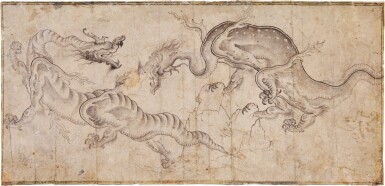
Fighting Dragons, Persia, Safavid, 16th century
Auction Closed
October 27, 03:41 PM GMT
Estimate
8,000 - 12,000 GBP
Lot Details
Description
pen and ink, grey wash on paper, borders trimmed
8.6 by 18cm.
In the sixteenth century, drawing assumed a new role in Safavid Iran with a discernible shift from manuscript illustration to artworks being produced as single-page compositions for independent albums. This was probably due to patronage given to artists outside the court from courtiers, government officials and wealthy merchants.
This powerful image is of two reptilian figures of dragons attacking each other in a rocky landscape. The imagery of the dragon in Persian art is derived from earlier Central Asian and Chinese prototypes, as well as from various dragon and hero scenes in Ferdausi’s epic, the Shahnameh, in which Persian heroes such as Isfandiyar, Bahram Gur and Rustam were depicted slaying dragons. Dragons were seen as fearful, mythical monsters often illustrated in Persian paintings and drawings in combat with a warrior, a simurgh, a lion or a ch’i-lin (a Chinese chimerical creature).
The finely executed, sinuous forms of our dragons, and the face of the beast on the left, find parallels with an earlier fifteenth century Persian decorative drawing of an arabesque which terminates in a ferocious dragon head. The drawing was formerly in the Stuart Cary Welch Collection and is now in Harvard University Art Museums (acc.no. 1999.287; illus. in Welch 2004, pp.38-39, no.1). The heads of our dragons are also similar to a drawing of a dragon in combat with a hero, attributed to Mir Sayyid Muhammad al-Naqqash, produced in Tabriz circa 1550 (76.1999.43; ibid., pp.48-49, no.5). The dragon on the right in the present lot is comparable to a sixteenth century Safavid drawing from Qazvin in the Metropolitan Museum of Art which depicts a dragon emerging from a rocky landscape as it gets attacked by a warrior on horseback (acc.no. 25.83.7; Swietochowski 1989, pp.28-29, cat.no.9).
This subject remained popular in later Persian painting as well as at other painting centres beyond Iran, such as Ottoman Turkey and India. Sixteenth century Persian artists such as Mir Sayyid Muhammmad al-Naqqash and Shah Quli found favour at the Ottoman court and moved to Constantinople. A drawing of a dragon amidst foliage of serrated saz leaves by Shah Quli dated to circa 1540-50 is in The Metropolitan Museum of Art, New York (acc.no.57.51.26).
You May Also Like


