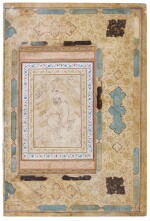

A dervish holding a book, signed by Muhammad Muhsin, Persia, Safavid, Isfahan, second quarter 17th century
Auction Closed
October 27, 03:41 PM GMT
Estimate
5,000 - 7,000 GBP
Lot Details
Description
ink and colour wash on paper, signed at left 'raqam-e Muhsin', laid down on an album page with illuminated borders
Image: 7.5 by 11.7cm; leaf: 34.6 by 23.2cm.
This drawing is by Muhammad Muhsin, who was one of the leading artists of the first generation after Reza-i Abbasi, alongside Muhammad Yusuf, Muhammad Ali and Muhammad Qasim. He flourished in the second quarter of the seventeenth century and signed examples of his work are rare. Other drawings by him are the David Collection, Copenhagen (145/2006, the figure has an almost identical face to the present figure); the National Museum of Asian Art, Washington D.C. (F1912.99 and F1947.23, where the signature is identical to the present example), and the Hermitage Museum, St. Petersburg (VP-734).
This solemnly commanding portrait of a dervish represents a genre that gained enormous popularity in the hands of such masters as Riza 'Abbasi and Sadiqi Beg at the close of the sixteenth century, and the beginning of the seventeenth. The lonely figure cut by an ascetic gained religious credibility and gravitas after Shah 'Abbas' infamous suppression of the Sufis in 1593. Indeed their romantic appeal to the free-thinking artists and patrons of the era intensified as a result of such political actions, and so numerous portraits of elderly pilgrims and dervishes were commissioned and painted (Canby 1999, p.106).
These portraits exhibit a great sensitivity for the plight of such deeply religious men. As is so clear here, the solitary figure is imbued with a reverence lacking in contemporary representations of pretty youths and amorous lovers.
You May Also Like


