
Property from the Collection of Jerry and Ilene Liebowitz
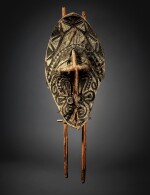
Purari Barkcloth Mask, Gulf of Papua, Gulf Province, Papua New Guinea
Lot Closed
May 18, 06:25 PM GMT
Estimate
25,000 - 35,000 USD
Lot Details
Description
Property from the Collection of Jerry and Ilene Liebowitz
Purari Barkcloth Mask, Gulf of Papua, Gulf Province, Papua New Guinea
Height: 30 3/4 in (78 cm)
Pierre and Claude Vérité, Paris
John and Marcia Friede, Rye, New York
Sotheby's, Paris, June 16, 2010, lot 7, consigned by the above
Jerry and Ilene Liebowitz, Fort Lee, New Jersey, acquired at the above auction
Purari masks from the Papuan Gulf were amongst the works which were collected and prized in the early twentieth century by the Surrealists (cf. pl. VII of the auction catalogue for the sale of André Breton and Paul Eluard's collection, Paris, July 1931, in 'Primitivism', 1984: 114).
The uncertain contours of the form and the ethereal structure of these masks, which are made of plant matter (coconut fibre) and rattan, contrasts with the rich character of the patterns which cover the surface. Demarcated by the sago palm stems of sago which are fastened to the plant matter an array of sophisticated designs and curvilinear tattoo motifs cover the entire surface of the face. The impact of the design is increased by the stark black and white pigments, and by the red hue of the median ridge, which stands out in high relief.
Used in the annual aiai'imunu festival, Purari masks fall into two types. The first consists of monumental masks, which can measure up to six metres in height, and the second of smaller masks such as the offered lot, which are known as apuai (Wirz, 1934). Both types personified ancestral spirits, especially those of the forest, iri imunu, whilst smaller masks also had the role of providing food for the large masks (Bell in Peltier, 2006: 211 and 421). According to Welsch in addition to their high cultural importance these masks played a key role in strengthening the clan ties between the large Purari communities, (Welsch, Webb and Harara, 2006: 29).
In 1946, the Tom Kabu movement in the Purari Delta led to the abandonment of traditional rituals and the objects that had accompanied them. The quality of the composition, the density and complexity of the decoration, and the fine condition of the surface all allow one to link this mask with examples collected at the beginning of the 20th century. Cf. Welsch, Webb and Harara (2006: 30, No. 48) for a very similar mask now in the Field Museum in Chicago (inv. No. 142436), collected in 1912 by A.B. Lewis and Joseph N. Field during the South Pacific Expedition of 1910-1913
You May Also Like


