Ludwig Deutsch
The Palace Guard
Auction Closed
November 9, 04:41 PM GMT
Estimate
40,000 - 60,000 GBP
Lot Details
Description
Ludwig Deutsch
Austrian
1855 - 1935
The Palace Guard
signed L. Deutsch upper left
oil on panel
Unframed: 24 by 17cm., 9½ by 6¾in.
Framed: 44.4 by 37cm., 17½ by 14½in.
Acquired from the above by the present owner
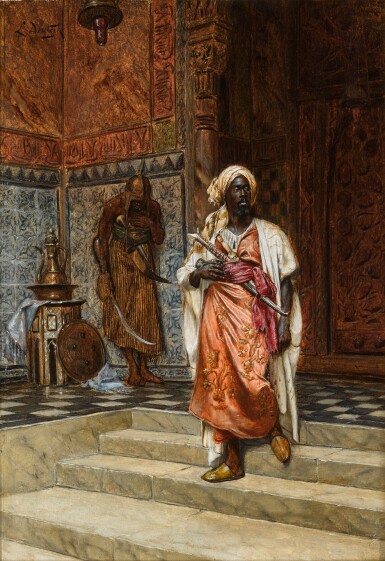
Images of standing guards, Deutsch's signature subject, arguably form the foundation of his legacy. Even his small-scale works offers offer a pristine palette and incredible attention to detail. Every vein in the Nubian guard's arm and hands, every reflection of light in his face, and every fold in his robes is observed minutely. To achieve this degree of verisimilitude, Deutsch relied not only on a magnifying glass but also, like Jean-Léon Gérôme, on photographs amassed in Cairo, and on props brought back from his travels. The oil lamp, mother-of-pearl inlaid gueridon table, and brass pitcher seen in the present work may well have been objects Deutsch kept in his Paris studio.
Yet Deutsch's portraits go beyond the photographic. Unlike a photograph which manifests itself in a fraction of a second, a painting like this, offering the illusion of a photographic snap-shot, took weeks or perhaps months to complete. While crafting the work, the artist expresses his sitter's personality, mien, and anatomy, as well as the setting with greater depth. The result, which photography cannot emulate, is an enhanced reality that allows a narrative tension to unfold through the layers of thought and observation that underpin it.
The viewer is struck, for example, by the Nubian's ambiguous stance. His station as a senior guard (being bowed to by a subordinate) demands unfettered masculinity, yet he appears authentically human, his gaze distant, lost in thought. And who or what is he guarding? The dark recesses of the portal behind him reveal little. Perhaps we will never know, just as Deutsch, on his travels to Egypt, conceded that the regions he frequented held secrets that foreign visitors could never discover.
You May Also Like


