Property from a Swiss Private Collection
A Roman Marble Janiform Herm of a Young and Old Triton, circa 2nd Century A.D.
Auction Closed
July 4, 03:04 PM GMT
Estimate
30,000 - 50,000 GBP
Lot Details
Description
Property from a Swiss Private Collection
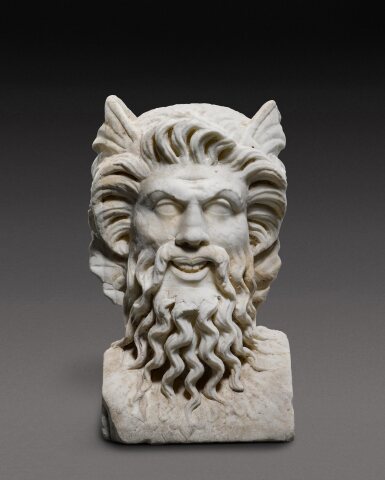
A Roman Marble Janiform Herm of a Young and Old Triton
circa 2nd Century A.D.
the youthful Triton with parted lips, furrowed brow, and pointed ears, his hair swept up over the forehead and temples, a pair of fins above the forehead and another flanking the mouth, the older triton with full beard and moustache, grinning mouth with visible teeth, and furrowed brow, his hair swept up over the forehead and temples, a pair of fins above the forehead, the shoulders decorated with fish scales on both sides.
Height 35.7 cm.
found at Nemi in 1885 by Sir John Lumley Savile, 1st Baron Savile (1818-1896)
Prince Filippo Orsini
Attilio Simonetti (1843-1925), Via Margutta, Rome
William Waldorf Astor, later Viscount Astor of Hever (1848-1919), acquired from the above circa 1903
Gavin Astor, 2nd Baron Astor of Hever (Sotheby’s, London, July 11th-12th, 1983, no. 376)
Pino Donati Arte Classica, Lugano
Swiss private collection
acquired by the present owner from the above
Published
Wolfgang Helbig, "Scavi di Nemi," Bullettino dell’instituto di corrispondenza archeologica, 1885, p. 227f.
John Savile Lumley, "Excavations at Nemi," Journal of the British and American Archaeological Society of Rome, vol. 1 (no. 2), 1885-86, p. 67
John Savile and G. Harry Wallis, Catalogue of Classical Antiquities from the Site of the Temple of Diana, Nemi, Italy, Nottingham, 1891, p. 41, no. 611
John Savile and G. Harry Wallis, Illustrated Catalogue of Classical Antiquities from the Site of the Temple of Diana, Nemi, Italy, Nottingham, 1893, p. 32f., no. 611, illus.
Lucia Morpurgo, "La rappresentazione figurata di Virbio," Ausonia, vol. 4, 1909, p. 113ff., pl. 6
Frederik Poulsen, "Nemi Studies," Acta Archaeologica, vol. 12, 1941, p. 29f., fig. 25
Gavin Astor, Statuary and Sculpture at Hever, Ipswich, 1969, n. 145
Mette Moltesen, ed., I Dianas hellige Lund. Fund fra en helligdom i Nemi, Copenhagen, 1997, p. 135, no. 10
Mette Moltesen, "The marbles from Nemi in exile: sculpture in Copenhagen, Nottingham, and Philadelphia," in: J. Rasmus Brandt et al., eds., Nemi – status quo. Recent research at Nemi and the sanctuary of Diana, Rome, 2000, p. 116f., fig. 9
Stephanie Dimas et al., Die Antikensammlungen von Hever Castle, Cliveden, Bignor Park und Knole, Wiesbaden, 2013, p. 66ff., no. He 20, pl. 22f.
https://arachne.dainst.org/entity/1067473
https://arachne.dainst.org/entity/1067474
https://arachne.dainst.org/entity/199841
The present herm was found in 1885 in the sanctuary of the goddess Diana at Nemi during excavations undertaken by Sir John Savile Lumley, the British ambassador in Rome from 1883 to 1888. The sculptures found there were divided between Prince Orsini, on whose property the sanctuary was situated, and the ambassador. Only a plaster cast of the herm was sent with the ambassador’s other objects to his hometown Nottingham (now Nottingham, Castle Museum, inv. N 611); the herm itself went to the Roman art market and was acquired circa 1903 by William Waldorf Astor for his collection at Hever Castle.
The present herm was previously set on a pillar with a short dedicatory inscription to the goddess Diana (CIL XIV no. 4185: SACR DIAN). This pillar was found in the same place as the herm; they remained together until the Replica Shoes ’s sale in 1983.
An almost identical herm, which was found in the late 18th century apparently on the same site, is now in Copenhagen: M. Moltesen, ed., Catalogue Ny Carlsberg Glyptotek. Imperial Rome, vol. 3, 2005, p. 236f., no. 112; https://arachne.dainst.org/entity/1068963. It was suggested that the heads of both herms represent sea creatures, probably Tritons, and might be identified as personifications of lakes Albano and Nemi. Another example is in the Vatican (see G. Lippold, Die Skulpturen des Vatikanischen Museums, vol. III.2, 1956, pp. 473 f., no. 38; https://arachne.dainst.org/entity/1080168).
You May Also Like


