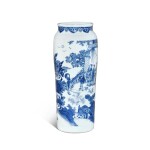
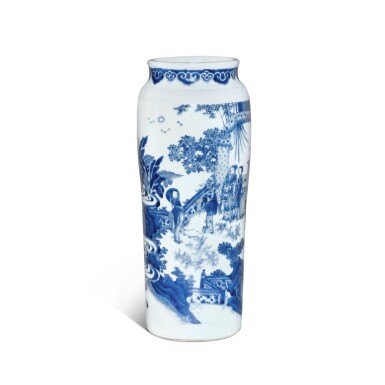
A Chinese Blue and White 'Promotion' Sleeve Vase, Transitional Period, Circa 1640
過渡期 約1640年 青花加官進爵圖筒瓶
Auction Closed
April 21, 06:04 PM GMT
Estimate
40,000 - 60,000 USD
Lot Details
Description
A Chinese Blue and White 'Promotion' Sleeve Vase
Transitional Period, Circa 1640
過渡期 約1640年 青花加官進爵圖筒瓶
16¼ in. (41.3 cm.) high
Collection of President Herbert Hoover (1874-1964), New York, no. 180
Collection of Mr and Mrs Allan Hoover (1907-1993), San Francisco
Ralph M. Chait Galleries, New York
Wolf Family Collection No. 0797 (acquired from the above on April 10, 1985)
The political turmoil of the Transitional period resulted in the loss of Ming imperial control over the Jingdezhen kilns. During this time, artisans were free to create porcelains in response to popular tastes, resulting in much innovation in the form of new themes, subject matter, motifs, and painting styles on porcelain. Narrative scenes became especially popular, a trend driven in large part by highly educated scholar-officials, who appreciated the various classical stories and idioms depicted on porcelain. This elegant and animated blue and white vase is a perfect example of the strong literati influence on Transitional period ceramics. The format of the painting– a continuous scene encircling the entire vase– requires one to turn the vessel to appreciate the entire vignette, akin to the unrolling of a literati handscroll. The scene is masterfully and delicately rendered. Broad swathes of pale wash and fine inky blue lines express a range of details, textures, and surfaces within the painted scene, from misty clouds, jagged rocks, to luxuriously draped fabric and swaying silk sashes. The unforgiving nature of the blue and white medium, coupled with the intricacy of the scene, indicates that the painter of this vase was exceptionally skilled.
At first glance, the composition appears to present a pleasant view of an official listening to music, watching a dance performance, enjoying food and beverage, all surrounded by leafy trees and rocks in a balustraded garden setting. However, closer inspection reveals an attendant offering an archaic jue vessel to the official. The scene is a conceit for the Chinese idiom jiaguan jinjue 加官進爵 (promotion to higher rank or nobility). The word jue can refer to rank or nobility, as well as the ritual vessel, and the scene cleverly plays on this double meaning to depict a verbal blessing in visual form. The well-wishing, congratulatory sentiment is furthered by the ruyi (as you wish) border at the neck, which is rare amongst sleeve vases, which are more often decorated with a border of upright leaves at the neck. It is highly possible that the present piece was gifted to a scholar-official in the 17th century, or even a young student with dreams of passing the imperial examinations.
This subject matter was popular throughout the Transitional period. Compare a jar attributed to circa 1620-1644, painted with a similar scene of an official presenting a jue on the cover and an official presenting a hat (guan) on the body, in the collection of the British Museum (accession no. OA F.1473), illustrated in Jessica Harrison-Hall, Catalogue of Late Yuan and Ming Ceramics in the British Museum, London, 2001, pl. 12:75. A Shunzhi period dish dated to 1658 in the Palace Museum, Beijing, depicts an official receiving a hat, published in The Complete Collection of Treasures of the Palace Museum: Blue and White Porcelain with Underglazed Red (III), vol. 35, Hong Kong, 2000, pl. 3. A Kangxi period blue and white phoenix-tail vase painted with the same theme was sold in these rooms, September 14, 2019, lot 1585.
For related blue and white sleeve vases, compare one attributed to 1630-1644, featuring an official and his entourage in a garden, exhibited in Transitional Wares and Their Forerunners, Hong Kong Museum of Art, Hong Kong, 1981, cat. no. 63. One painted with a scene representing zhegui 折桂 (to pluck an osmanthus branch), which conveys success in the imperial examinations and an official's blossoming career, was sold in our Hong Kong rooms, November 30, 2021, lot 404. Another depicting an official receiving a vase was sold at Christie's London, May 15, 2017, lot 711. Finally, compare one painted with officials and a cowherd, in the collection of the Royal Ontario Museum, Toronto (accession no. 998.110.1).
You May Also Like


