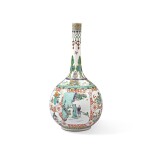

A Chinese Famille-Verte 'Scholars' Bottle Vase, Qing Dynasty, Kangxi Period
清康熙 五彩開光高士圖長頸瓶
Auction Closed
April 21, 06:04 PM GMT
Estimate
40,000 - 60,000 USD
Lot Details
Description
A Chinese Famille-Verte 'Scholars' Bottle Vase
Qing Dynasty, Kangxi Period
清康熙 五彩開光高士圖長頸瓶
17 in. (43.2 cm.) high
Sotheby's New York, June 4, 1985, lot 53
[with] Ralph M. Chait Galleries, New York (acquired from the above)
Wolf Family Collection No. 0803 (acquired from the above on June 4, 1985)
Brilliantly painted and enameled, the present vase is a superlative example of Kangxi period porcelain and the famille-verte palette. No expense was spared in its design, with every inch of its surface covered in brilliantly fired, jewel-like enamels. The vessel is replete with auspicious decoration— peach, leaf, and finger citron-shaped panels enclose well-wishing vignettes such as flowers and antiques, magpies and plum blossoms, butterflies amongst flowers, a Buddhist lion playing with a ball, and a landscape scene. The shoulder is painted with a collar containing fish, which have associations with Daoist philosophy and happiness, while suspended jewels, trigrams, the yin-yang symbol and archaistic dragons adorn the long neck.
Aside from its exuberant ornamentation, the present vase is also exceptionally rare for its scholarly subject matter, which is depicted on the body in three rectangular panels. One panel features a man lounging on a rock as if awaking from slumber. Both he and his attendant observe a butterfly flitting nearby, recalling Zhuangzi's famous dream as a butterfly. Another panel features the revered Song dynasty poet, scholar, and polymath Su Shi (1037-1101), also known as Su Dongpo. He writes on a rock face with a brush, representing his famous poem Ti Xilin Bi 题西林壁 (Written on the Wall at West Forest Temple). The poem was composed in 1084 when Su Shi was visiting Mount Lu in Jiangxi province. It lauds the beauty of the mountainous landscape, and is also a philosophical commentary on the difficulty—or impossibility—of objective perception due to people's varying positions in life:
From the side, a whole range; from the end, a single peak:
Far, near, high, low, no two parts alike.
Why can’t I tell the true shape of Lushan?
Because I myself am in the mountain.
(Translation by Burton Watson)
The scholarly subject matter and the various levels of conceit on this vase would certainly have been highly appreciated by the erudite literati of the 17th and early 18th centuries.
No closely related vessel with this combination of subject matter and decoration appears to exist. However, compare a similarly decorated iron-red and gilt bottle vase, depicting birds and animals within the main reserves on a related floral scroll ground, illustrated in Kangxi Porcelain Wares from the Shanghai Museum Collection, Shanghai, 1998, pl. 189.
You May Also Like


