
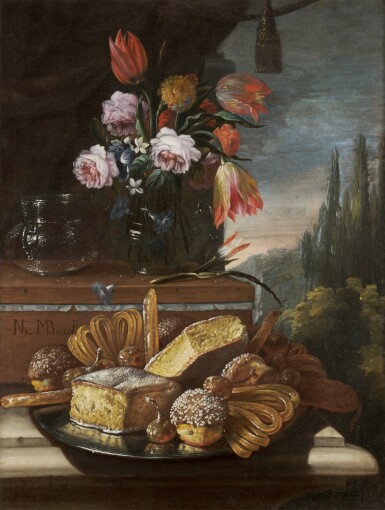
Nicola Massa Recco
Still life of cakes and biscuits on a pewter plate, variegated tulips, roses, carnations and other flowers in a glass vase on a wooden box, all on a stone ledge, a forest landscape in the distance
Estimate
15,000 - 20,000 EUR
Lot Details
Description
Nicola Massa Recco
Naples 1663–before 1752
Still life of cakes and biscuits on a pewter plate, variegated tulips, roses, carnations and other flowers in a glass vase on a wooden box, all on a stone ledge, a forest landscape in the distance
signed lower left on the wooden box: Nic:MReccoF. (MR in ligature)
oil on canvas
unframed: 100 x 76 cm.; 39⅜ x 29⅞ in.
framed: 123.1 x 97.5 cm.; 48½ x 38⅜ in.
Anonymous sale, Amsterdam, Paul Brandt, 20–23 May 1969, lot 68;
Anonymous sale, Milan, Replica Shoes ’s, 14 June 2011, lot 54;
Acquired subsequently by the present owner.
G. Forgione, Nuovi contributi sulla natura morta napoletana. Nicola Massa Recco e altre questioni, exh. cat., Florence 2019, pp. 22, 25, 26 and 53, fig. 10, reproduced in colour.
This rare, beautifully signed canvas has been singled out by Gianluca Forgione as one of Nicola Massa Recco’s finest creations, with a quality rivaling that of the still lifes of his celebrated uncle, Giuseppe Recco (1634–1695). Although the artist is primarily known for his depictions of fish and game, the present work stands out within Massa Recco’s relatively little-known œuvre, the reconstruction of which remains an ongoing subject of scholarly study.
Long thought to have been one of Giuseppe Recco’s twelve children, the artist’s true relationship to the Neapolitan painter was clarified only recently. In 2018, Valeria Di Fratta demonstrated that Nicola was in fact the son of Marzia Recco, Giuseppe’s sister, and Antonio de Massa.1 This discovery has been instrumental not only in refining the artist’s biography but also in understanding the evolution of his signature, which provides an important indication for establishing the chronology of his works. In his earlier paintings he generally signed himself Nicola Massa (or de Massa)2, while in later years—probably after 1702—he began adding the surname Recco, thus adopting the form Nicola Massa Recco. This addition may have served to emphasize his familial connection to the renowned painter and to associate his work more closely with the prestigious artistic lineage of the Recco family. The presence of the Recco name in the signature of the present painting therefore suggests that it belongs to a later phase of the artist’s production.
1 V. Di Fratta, 'Nuove notizie per la vita di Giuseppe Recco e di altri esponenti della sua famiglia', in Napoli Nobilissima, vol. LXXV, September–December 2018, pp. 20–21 and 26–27.
2 See for example the work dated 1686 formerly with Michele Gargiulo Antiquario, Naples; Forgione 2019, pp. 16–18, reproduced in colour.
You May Also Like


