
Roman School, 17th century
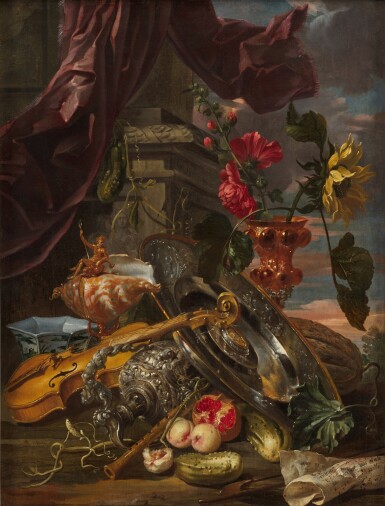
Still life with a violin, a recorder, a gilt nautilus cup, a silver ewer, a silver charger and other precious objects, in a garden landscape with cucumbers, peaches and other fruit
Estimate
20,000 - 30,000 EUR
Lot Details
Description
Roman School, 17th century
Still life with a violin, a recorder, a gilt nautilus cup, a silver ewer, a silver charger and other precious objects, in a garden landscape with cucumbers, peaches and other fruit
oil on canvas
unframed: 111.6 x 58.3 cm.; 44 x 23 in.
framed: 143.1 x 117 cm.; 56⅜ x 46⅛ in.
This work is accompanied by an Export License. We suggest contacting shipping.milan@sothebys.com for additional details on procedures and timing.
Anonymous sale, Stockholm, Bukowskis, 5–8 November 1958, lot 298 (as Christian Berentz);
Anonymous sale, Paris, Drouot, 23 April 1990, lot 107 (as Flemish School, circa 1700);
Anonymous sale, Milan, Replica Shoes 's, 4 June 2003, lot 18, for €33,600 (as Gabriele Salci);
Anonymous sale, Munich, Hampel, 28 March 2014, lot 1044 (as Gabriele Salci);
Acquired subsequently by the present owner.
A. Orlando, 'Van Dyck e gli altri fiamminghi verso il crepuscolo del "Secolo dei Genovesi"', in Van Dyck e i suoi amici. Fiamminghi a Genova 1600–1640, A. Orlando (ed.), exh. cat., Genova 2018, pp. 36–37, reproduced in colour and in detail figs 29 and 30 (as Pieter Boel).
The authorship of this elegant canvas has been the subject of discussion among scholars since its first appearance at auction in Sweden in 1958, bearing attributions to Christian Berentz (1658–1722), Gabriele Salci (active in the first half of the 18th century), and more recently Pieter Boel (1622–1674). The slick execution and the overall elaborate composition point towards an artist working in Rome towards the end of the seventeenth and early eighteenth centuries. Particularly notable is the confident rendering of the individual elements, which are described with a clarity and precision characteristic of artists working within the Northern tradition while adapting to the decorative tastes of Roman patrons, a combination that was a defining feature of the artistic environment in Rome at the turn of the eighteenth century. Although a definitive attribution remains elusive, the work clearly belongs to this vibrant artistic context and stands as an accomplished example of the genre.
We are grateful to all those consulted for their views.
You May Also Like


