
Giuseppe Bonito
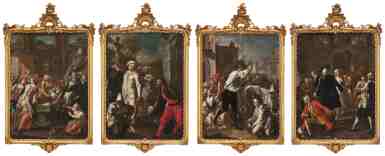
Four genere scenes: The sick dog; Commedia dell'arte characters; A street scene; The ball
Estimate
40,000 - 60,000 EUR
Lot Details
Description
Giuseppe Bonito
Castellammare di Stabia, near Naples 1707–1789 Naples
Four genre scenes: The sick dog; Commedia dell'arte characters; A street scene; The ball
a set of four, all oil on canvas
the first unframed: 101.7 x 75.4 cm.; 40 x 29¾ in.
framed: 139.5 x 87.2 cm.; 54⅞ x 34⅜ in.
the second unframed: 102.4 x 75.2 cm.; 40¼ x 29⅝ in.
framed: 139.5 x 87.2 cm.; 54⅞ x 34⅜ in.
the third unframed: 101.5 x 75.1 cm.; 40 x 29⅝ in.
framed: 142 x 87 cm.; 55⅞ x 34¼ in.
the fourth unframed: 101.6 x 75.1 cm.; 40 x 29⅝ in.
framed: 140 x 87.6 cm.; 55⅛ x 34½ in.
(4)
This work is accompanied by an Export License. We suggest contacting shipping.milan@sothebys.com for additional details on procedures and timing.
Achille Lauro (1887–1982), Naples, by 1980;
Art market, Venice;
Evelina Levi Broglio (1931–2007), Casetta Rossa, Venice;
Her posthumous sale ('Gli Arredi della Casetta Rossa di Evelina Levi Broglio'), Milan, Il Ponte, 15 October 2014, lot 533;
Acquired subsequently by the present owner.
N. Spinosa, 'La pittura del '700', in Cultura materiale, arti e territorio in Campania, supplement to La voce della Campania, VIII, 1980, p. 462, reproduced fig. 9 (only The sick dog);
N. Spinosa, Pittura Napoletana del Settecento. Dal Barocco al Rococò, Naples 1986, vol. I., pp. 168, 366–67, reproduced figs 352–55;
A. della Ragione, Giuseppe Bonito. Opera completa, Naples 2014, pp. 8, 44 and 50–51, reproduced figs 014–017.
Dated by Nicola Spinosa to the end of the 1730s, this extraordinary set of canvases by Giuseppe Bonito belongs to the formative phase of the artist's career, when his engagement with contemporary Neapolitan genre painting was at its most vivid and experimental. Rejecting the grandiloquence of sacred and mythological painting that had long dominated Neapolitan taste, Bonito turned instead to scenes drawn from the lived reality of his city, often depicting bourgeois amusements, popular masquerades, schoolrooms, studios, card games, concerts, and domestic incidents. Rather than satire in the strict sense, these scenes offer a broadly human comedy, transforming everyday settings and protagonists into a theatrical microcosm of eighteenth-century Neapolitan life. Often executed in a colourful and highly distinctive style, this humorous group of canvases was, in the words of his early biographer Bernardo de' Dominici (1683–1759), 'praised by all the people' and 'won him a great reputation',1 particularly among a new group of patrons from the emerging Neapolitan bourgeoisie, whose taste was less courtly and academic than that of the old-guard aristocracy.
Trained in Naples in the workshop of Francesco Solimena (1657–1747), Bonito soon became a sought-after portrait painter for the Bourbon court, while also distinguishing himself as an original interpreter of genre painting. Although undoubtedly influenced by the teachings of his master, as well as by the works of the older Francesco De Mura (1696–1782), Bonito’s work is distinguished by a sense of reality and a vitality, deeply rooted in the tradition of Neapolitan naturalism which he endeavored to preserve in the face of the new classicism filtering into Naples from Rome.
1 B. De’ Dominici, Vite de' Pittori, Scultori, ed Architetti Napoletani, Naples 1742, vol. III, p. 713.
You May Also Like


