
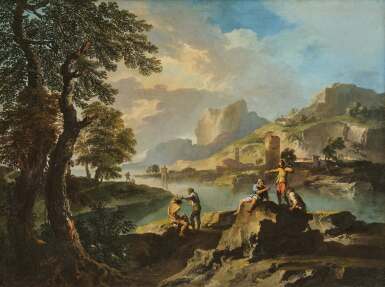
Andrea Locatelli
An Italianate coastal landscape with figures resting by the foreground, a town in the distance
Estimate
15,000 - 20,000 EUR
Lot Details
Description
Andrea Locatelli
Rome 1695–1741
An Italianate coastal landscape with figures resting by the foreground, a town in the distance
oil on canvas
unframed: 73.4 x 97.5 cm.; 28⅞ x 38⅜ in.
framed: 92.6 x 117.5 cm.; 36½ x 46¼ in.
Margherita Rospigliosi, née Colonna Gioeni (1786–1864), Princess of Castiglione, Palazzo Pallavicini-Rospigliosi, Rome (according to a label on the reverse);
Probably thence by descent to her son Prince Don Clemente Rospigliosi (1823–1897), Palazzo Pallavicini-Rospigliosi, Rome;
Probably thence by descent to his son Prince Don Giuseppe Rospigliosi (1848–1913), Palazzo Pallavicini-Rospigliosi, Rome;
Probably thence by descent to his son Prince Don Girolamo Rospigliosi (1907–1959), Palazzo Pallavicini-Rospigliosi, Rome;
His sale, Rome, Galleria Sesiteri and Casa di Vendite Guido Tavazzi, 30 April 1931, lot 206 (as Salvator Rosa);
Marchese Edoardo Cassis Faraone, Rome, by 1976;
Anonymous sale, Rome, Christie's, 17 December 2003, lot 491 (as Andrea Locatelli);
Acquired subsequently by the present owner.
A. Busiri Vici, Andrea Locatelli, Rome 1976, pp. 79–80, no. 39, reproduced fig. 98 (as Andrea Locatelli);
A. Negro, La Collezione Rospigliosi, Rome 2007, pp. 377–79, no. 206 (as Salvator Rosa).
Described by Andrea Busiri Vici as 'tra le più felici di Andrea Locatelli', this luminous and beautifully preserved landscape dates to the artist's early years in Rome, shortly after 1720 (see Literature). Incorrectly attributed to Salvator Rosa (1615–1673) in 1931, it bears the unmistakable influence of the Neapolitan painter in its dramatic treatment of nature and irregular compositional structure. While Locatelli later developed a more balanced and classical approach to landscape painting, Rosa’s expressive and theatrical vision of nature helped shape the foundations of his artistic style.
This work boasts impeccable provenance, having remained for at least a century in the Palazzo Pallavicini-Rospigliosi collection in Rome. According to a label on the reverse of the canvas, it was in the collection of Margherita Rospigliosi, née Margherita Colonna Gioeni (1786–1864), Princess of Castiglione, and was kept at the family’s Roman residence. The painting remained in the Rospigliosi family collection until it was sold in 1931, testifying to its long-standing presence within one of Rome’s most distinguished aristocratic collections.
You May Also Like


