
Property from an Important Private Collection
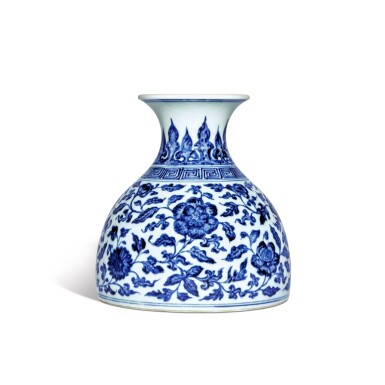
A fine and exceedingly rare blue and white Ming-style 'flower' vase, Mark and period of Yongzheng
Live auction begins on:
March 25, 01:30 PM GMT
Estimate
400,000 - 600,000 USD
Lot Details
Description
the base with a six-character mark in underglaze blue within a double circle
Height 6⅜ in., 16.1 cm
Acquired in 2004.
Its luminous white body providing a pristine ground for the finest cobalt decoration, the present vase is an exemplary relic of the Yongzheng kilns. More typically found on larger scale commissions, the present decorative scheme is applied with extraordinary control and fluency: scrolling flowers of the four seasons unfold rhythmically across its rounded body, their delicately shaded petals and leaves revealing a painterly sensitivity more often associated with ink on silk than pigment on porcelain. The balance between form and ornament is similarly masterful: the swelling lower body anchors the design, while the flaring neck, encircled by a band of upright lappets, introduces a measured verticality. The result is a vessel of poised restraint and subtle richness, whose beauty lies not in excess, but in precision, harmony, and clarity of intention.
The vase speaks directly to the Yongzheng Emperor’s deep engagement with archaism and his reverence for the porcelains of the Ming dynasty. During his reign (1723–1735), imperial taste was guided by a scholarly impulse to recover, reinterpret, and refine classical models, particularly the blue and white pieces of the Yongle (1403–1424) and Xuande (1426–1435) reigns. Antique defects such as ‘heaping and piling’ – the initially unintentional spotting of early cobalt pigments – had become a much celebrated feature of the Ming treasures preserved in the Yongzheng court and, in a conspicuous nod to his predecessors’ reign, the Yongzheng Emperor sought to replicate these effects, injected with the technical mastery of the eighteenth century. Intentionally adding uneven dottings of underglaze blue across the floral designs and formal bands of the present vase, the imperial craftsmen were able to produce a rich variegated surface, akin to the finest Yongle and Xuande wares.
However, rather than simple imitation, Yongzheng wares are also characterized by a conscious process of distillation— paring back forms and motifs to their essential qualities while elevating technical refinement to unprecedented levels. The present vase reflects this aesthetic philosophy: its floral decoration recalls Ming prototypes in both subject and compositional density, yet the palette is more restrained, the brushwork more controlled, and the overall effect one of intellectual elegance rather than exuberance. Such works embody the Yongzheng ideal of harmony between past and present, tradition and innovation.
With its compressed globular body rising to a tall, gently flaring neck, the enchanting form of the present vase is also noteworthy. Perhaps best described simply as a zun, the form appears to be all but unique to the Yongzheng period where it was reproduced in a number of variations. While scholarship remains unclear as to the origins of this form, some have proposed a continuum with flared waterpots of the Kangxi period known as taibaizun (‘beehive waterpots’) or contemporaneous vases derived from treasure pouch forms. Compare a Yongzheng Ge-type vase of pouch form in Gugong Bowuyuan cang Qingdai yuyao ciqi, vol. 1, pt. 2, Beijing, 2005, pl. 16; and another in the Nanjing Museum, in Treasures in the Royalty. The Official Kiln Porcelain of the Chinese Qing Dynasty, Shanghai, 2003, p. 193.
Other closely related upright fluted forms can also be found among a group of flambé-glazed wares of Yongzheng mark and period including those with molded chilong (of less dramatic fluting neck than present; see Zhongguo taoci quanji, vol. 14: Qing, pt. 1, Shanghai, 1999, pl. 236); and a wider vase in the Shanghai Museum in Zhou Lili, Qingdai Yongzheng - Xuantong guanyao ciqi [Qing dynasty official wares from the Yongzheng to Xuantong reigns], Shanghai, 2014, fig. 3-31; and a group of blue and white vases of baluster form, the upper sections of which closely resemble the present form (see Lu Minghua, ed. Qingdai qinghua ciqi jianshang, Shanghai, 1996, pl. 13). Finally compare a similarly elusive set of vases of closely related but slightly taller form with three molded rams heads, including a celadon example from the Jewett Collection sold at Christie’s New York, 20th September 2024, lot 1054; and a flambé example sold at Christie’s Hong Kong, 30th May 2006, lot 1369.
Surviving examples of this form decorated in blue-and-white are exceptionally rare with only one other vase apparently attested. The vase, preserved since its inception in the Qing Court Collection at the Palace Museum, Beijing, is illustrated in Geng Baochang, ed., Gugong Bowuyuan cang Qingdai yuyao ciqi [Porcelains from the Qing dynasty imperial kilns in the Palace Museum collection], Beijing, 2005, vol. 1, pt. 2, pl. 177.
For other market example wares of exemplary Yongzheng wares featuring similar floral scrolls and mastery of Ming imitation, compare the bottle vase from the collection of Charles Anderson Dana (1819-1897), sold in our Hong Kong rooms, 22nd April 2021, lot 3609; the flask from the Tianminlou Collection sold at Christie’s Hong Kong, 30th November 2023, lot 2711; and another of related design from the Koger Collection, sold at Christie’s New York, 19th September 2025, lot 1019.
You May Also Like


