
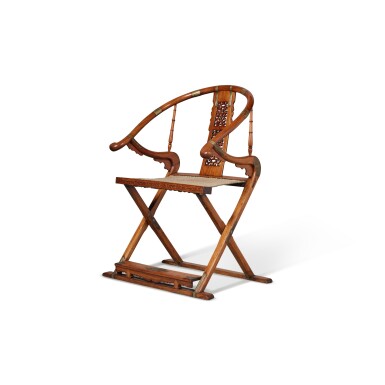
Huanghuali for the Scholar's Studio: An Important Private Collection of Classical Chinese Furniture
A very rare and important 'huanghuali' folding horseshoe-back armchair (Jiaoyi), Late Ming / early Qing dynasty, 17th century
Premium Lot
Live auction begins on:
March 25, 01:00 PM GMT
Estimate
1,200,000 - 2,000,000 USD
Premium Lot
Lot Details
Description
Height 42¾ in., 108.6 cm; Width 30⅛ in., 76.5 cm; Depth 23½ in., 59.7 cm
Collection of Frederic Mueller (1935-1989).
Museum of Classical Chinese Furniture, Renaissance, California.
Christie's New York, 29th November 1990, lot 395.
Robert Ellsworth, Chinese Furniture, New York, 1970, p. 88, col. pl. 26.
Wang Shixiang, Connoisseurship of Chinese Furniture, Hong Kong, 1990, vol. II, p. 55, pl. A92.
With its rounded crest rail, elegantly sculpted arms, and finely carved back splat, folding horseshoe-back armchairs (jiaoyi) like the present exemplify the apex of Ming-dynasty furniture design and have become nothing short of iconic in the eyes of the connoisseur. Conceived to be folded for easy transport, these portable chairs were naturally more prone to damage than other pieces of furniture and, as such, surviving examples are exceptionally rare and coveted. The present chair, preserved in remarkable condition and displaying a harmonious synthesis of form, material and construction, belongs to this most elite and rarefied group.
The term jiaoyi, literally meaning ‘crossed chair’, refers to the intersecting structure of the folding legs, a defining feature of the type. While folding chairs with straight backs were already in use during the Northern Song dynasty (960–1127), and appear in urban and domestic settings such as Zhang Zeduan’s celebrated handscroll Along the River during the Qingming Festival, the folding chair with horseshoe-shaped back represents a uniquely Chinese invention of the early twelfth century and a decisive advance in furniture design. An ingenious combination of an easy-to-carry folding chair and a comfortable armchair, the horseshoe-back jiaoyi constitutes a remarkable marriage of elegance and functionality. The continuous back and arm rail creates a smooth, fluid curve that gives the chair a dynamic shape with a variable but equally graceful silhouette whether seen straight on, from the side, or in three-quarter view. At the same time, it offers a sense of containment and ease by encircling the sitter’s upper body. The wide back splat, providing both structural support and comfort, allowed craftsmen to introduce restrained ornament without disrupting the chair’s essential linear clarity.
As such, while commonplace enough by 1436 to be included in an illustrated children’s primer of everyday objects (Xinbian duixiang siyan), before long, the jiaoyi had risen to ascendancy as a symbol of status and grandeur. As the enduring phrase diyiba jiaoyi (‘the first chair’) denotes, by the Ming and Qing dynasties, the jiaoyi had come to represent the seat of the highest-ranking individual in an assembly, the proverbial ‘throne’ of a scholar-elite.
Contemporary textual and visual sources attest to the prominence of the jiaoyi in elite culture. The Ming carpenter’s manual Lu Ban jing [Treatise of Lu Ban] provides a detailed description of the construction of folding horseshoe-back chairs and illustrates an official seated upon one, affirming its association with authority and status (Fig. 1). Woodblock-printed encyclopaedias such as the Yangzheng tujie [Cultivating rectitude, illustrated and explained] (Fig. 2) and Sancai tuhui [Collected illustrations of the Three Realms] further document the form, situating it among objects of refined and practical utility. This regal status of the jiaoyi is further exemplified in its presence in tombs. Frequently reproduced in miniature among the mingqi (‘spirit objects’) of official and imperial tombs, the jiaoyi presents itself as a chair of the elite; an eternal seat for the worthy. Two such armcharms – of tin and bronze – were excavated from the tomb of the Wanli Emperor (1573–1619), while others in glazed pottery are frequently found in officials’ tombs; see Jessica Harrison-Hall, Catalogue of Late Yuan and Ming Ceramics in the British Museum, London, 2001, pl. 20:8.
This historical and cultural significance is further evidenced by the frequent appearance of jiaoyi in imperial paintings and prints throughout the generations. The Ming painting Birthday Gathering in the Bamboo Garden by Lü Ji and Lü Wenying, in the Palace Museum, Beijing, shows some of the highest-ranking government officials of the day seated on folding round-back chairs. While the furniture represents the social status of the depicted, the antiques and scholarly paraphernalia surrounding them also suggest their aesthetic discernment and literary accomplishments. The symbolic potency of the form persisted and flourished into the Qing dynasty. In the 1757 work of Jesuit court artist Giuseppe Castiglione (1688–1766), for example, the Qianlong Emperor is rendered at ease receiving tribute horses from Kazakh envoys. Seated on a horseshoe-back folding chair addressing his tributaries, his leisurely posture and stately authority is accentuated by his throne-like chair. Though the depicted chair appears to be a Qing reinterpretation of the design, sporting dragon heads on the armrails, its presence as a ‘throne on the go’ reflects the high regard with which the Ming originals were held by the court, who preserved a number in their collection, and which are still found today in the Palace Museum, Beijing. Compare an understated Ming example illustrated in Hu Desheng, The Palace Museum Collection. A Treasury of Ming & Qing Dynasty Palace Furniture, vol. I, Beijing, 2007, pl. 62; alongside elaborate Qing interpretations, pls 63 and 65. Two further Ming jiaoyi of almost identical design are known; the first, sold in these rooms, 18th September 1996, lot 311, is preserved in the Minneapolis Institute of Art, Minneapolis (accession no. 98.80.3) (Fig. 3); and the second, formerly in the Gustave Ecke and Chen Mengjia Collections and now preserved in the Shanghai Museum, is illustrated by Wang Shixiang in Connoisseurship of Chinese Furniture, Hong Kong, 1990, pl. A90.
The technical sophistication required to execute these extraordinary forms should not be underestimated. The curved wooden frame is reinforced at critical points with artistically designed metal braces. As Sarah Handler has noted in her seminal study of the form, these elements reveal the extent to which Ming carpenters successfully overcame the considerable structural challenges inherent in a lightweight, collapsible design without compromising aesthetic refinement. Reaching its apogee during the Ming dynasty, when advances in joinery techniques enabled craftsmen to exploit the full potential of precious hardwoods such as huanghuali, valued for its strength, fragrance and luminous surface, the jiaoyi represents the exacting eye, scholarly taste and extraordinary eye of the Ming artisan; see Sarah Handler, ‘The Elegant Vagabond: The Chinese Folding Armchair,’ Orientations, January 1992, pp 90-96.
Surviving Ming examples of horseshoe-back jiaoyi are exceptionally rare with fewer than thirty surviving examples known to exist, the majority of which are preserved in museum collections. Compare a lacquer interpretation of the design in the Victoria and Albert Museum, London (accession no. FE.8-1976), illustrated by Harry Garner in Chinese Lacquer, London and Boston, 1979, p. 138, pl. 82 and considered to be ‘among the Museum’s most important Chinese treasures’; a widely published example now preserved in the Nelson-Atkins Museum, Kansas City, in Robert Ellsworth, Chinese Furniture. Hardwood Examples of the Ming and Early Ch’ing Dynasties, New York, 1971, pl. 27 and discussed at length in Sarah Handler, op. cit., p. 91, fig. 2; another from the George Crofts Collection in the Royal Ontario Museum, Toronto (accession no. 920.8) illustrated in Robert Ellsworth, op. cit. pl.28; and a fourth in the Pacific Asia Museum, Pasadena, illustrated by Lark E. Mason in ‘Examples of Ming Furniture in American Collections Formed Prior to 1980,’ Orientations, January 1992, p. 81, fig. 15.
The present chair is particularly noteworthy for its intricate openwork back-splat and appears to form part of a sub-group of folding chairs carved with auspicious motifs – in this case a stylized shou (‘longevity’) character, a bat (fu, a rebus for good fortune ‘fu’) and a jade chime. For other members of this group, compare: an armchair carved in relief with a closely related shou character on the splat, formerly in the Royal Ontario Museum, Toronto, and Museum of Classical Chinese Furniture in Renaissance, California, reputed to have been used by the Dowager Empress Cixi, and sold at Christie’s New York, 19th September 1996, lot 50, illustrated in Sarah Handler, Austere Luminosity of Chinese Classical Furniture, Berkeley, California, 2001, p. 61, fig. 5.1; another from the Mimi and Raymond Hung Collection, illustrated in R.H. Ellsworth, Chinese Furniture: One Hundred Examples from the Mimi and Raymond Hung Collection, New York, 1996, pl. 13 and sold at Christie’s Hong Kong, 1st December 2009, lot 1938; and another two with auspicious imagery in relief, apparently produced as a pair with mirrored ‘Three Friends of Winter’ designs: one sold in these rooms, 19th March 2007, lot 312; and the other in the Haven Collection, included in Classical Chinese Huanghuali Furniture from the Haven Collection, University Museum and Art Gallery, University of Hong Kong, Hong Kong, 2016, cat. no. 71.
Within this group of auspicious designs, those carved with intricate openwork appear to be the rarest, capable of highlighting the full range of the Ming carpenter’s abilities. For other jiaoyi with intricate openwork, compare three with splats depicting qilin amidst clouds: one from the collections of Mrs. Rafi Y. Mottahedeh and John W. Gruber, sold in these rooms, 19th October 1990, lot 618, again at Christie’s New York, 16th September 1998, lot 32 and again at Poly Beijing, 8th December 2018, lot 5405, with an upper window of closely related shou design; the second from the collection of Wang Shixiang, now in the Shanghai Museum, illustrated on the cover of Chinese Furniture: Selected Articles from Orientations, 1984-1999, Hong Kong, 1999; and the third from the collection of Dr S. Y. Yip in Karen Mazurkewich, Chinese Furniture. A Guide to Collecting Antiques, Rutland, 2006, fig. 15. Also compare the example carved with a related qilin design in relief below an openwork ruyi window, first sold at Christie's New York, 21st March 2002, lot 24; and later sold at Christie’s Hong Kong, 28th May 2021, lot 2809, as part of the Heveningham Hall Collection; and the largely undecorated example from the collection of Sir Joseph Hotung (Fig. 4), sold in our Hong Kong rooms, 8th October 2022, lot 11 for almost one hundred and twenty-five million Hong Kong dollars [15.8m USD].
Frederic Mueller (1935-1989) was a former partner at Pace Gallery and played an important role in its relocation from Boston to New York. In 1974, Mueller left the contemporary art world to focus on selling Asian art and antiques out of his gallery in Oahu, Hawaii, where he had grown up. Mueller's New York apartment, which juxtaposed classical Chinese furniture alongside large canvases by twentieth-century Abstract Expressionists, was captured by the photographer Horst P. Horst for the February 1971 issue of Vogue.