
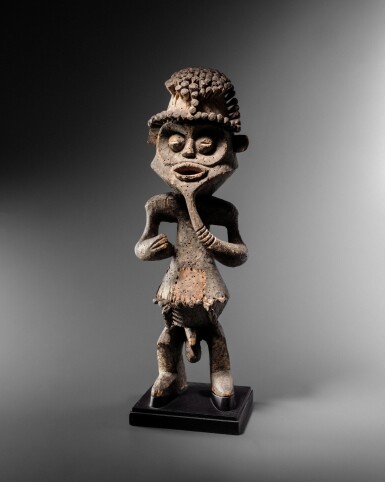
Mambila Figure, Cameroon
Estimate
20,000 - 25,000 EUR
Lot Details
Description
Mambila Figure, Cameroon
Height: 15 in ; Haut. 38 cm
Helmut Zake Collection, Heidelberg
Sotheby’s, Paris, Collections Andrea Portago, Roger Vanthournout, Helmut Zake et Divers Amateurs, June 23, 2006, lot 139
Daniel Hourdé Collection, Paris, acquired at the above auction
The art of the Mambila, who live between eastern Nigeria and western Cameroon, stands out for its highly inventive representations of the human body. Their wooden sculptures feature powerful volumes, marked concave surfaces and a sculptural style, which, in many ways, brings abstract forms to mind. Mambila figures are less a reflection of a desire for naturalism than a symbolic exploration of the body, where each element plays a part in the complex balance between geometry and expressive power.
This beautiful male figure, known as a Tatep, is attributed to the Mambila people of Cameroon or Nigeria. It features a highly stylised body, with almost cubist-like abstract qualities. Geometric volumes contrast planes and curves in succession and combine multiple perspectives: the upper chest projects forward, the arched torso is emphasised by a fan-shaped abdomen, while the tip of the left arm merges into the triangular chin.
The face features deep eye sockets with round eyes jutting out. The mouth, with its very pronounced oval shape, and the ears protruding strongly into the space, accentuate the expressive force of the figure. The high skull cap is crowned with hair rendered with attached wooden pegs, a technique also used to accentuate the abdominal belt.
The statue has a beautiful patina of use, enhanced by red pigments applied to the stomach - as a rectangular swath - as well as to the mouth and ears.
Wooden statues known as Tatep originate from the Donga Valley where the Mambila, Mfume and Kaka peoples live, and they are stylistically very similar to one another. The triangular face, deeply concave surfaces and striking formal design clearly tie this work to the Mambila statuary. However, the hair made of wooden pegs is more reminiscent of the work of the neighbouring Mfume and Kaka people.
A relevant connection can be drawn with a Mambila statue from the Barbier-Mueller collection, now kept at the Quai Branly Museum, which features a similar rendering of hair using attached wooden pegs.
Long interpreted as representations of ancestors, these figures have now come to be viewed in a new light. Some studies show that they are more likely to relate to ritual practices of a therapeutic nature - particularly to promote fertility or help prevent theft.
You May Also Like


