
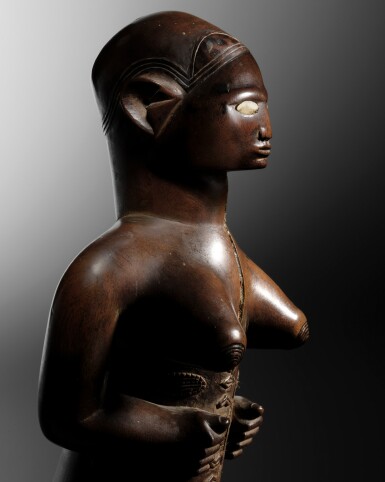
Bembe Gangala Figure, Democratic Republic of the Congo
Estimate
60,000 - 80,000 EUR
Lot Details
Description
Bembe Gangala Figure, Democratic Republic of the Congo
Height: 7 ⅞ in ; Haut. 20 cm
Beno d'Incelli Gallery, Paris, 1969
Stanley Marcus (1905-2001) Collection, Dallas
Sotheby's, New York, A passion for collecting: The eye of Stanley Marcus, November 16, 2002, lot 42
Johann Levy, Paris
Daniel and Carmen Klein Collection, Paris
Sotheby's, Paris, Arts d'Afrique et d'Océanie, June 24, 2015, lot 9, consigned by the above
Daniel Hourdé, Paris
Galerie Monbrison, Paris, 2022
Daniel Hourdé Collection, Paris
Johann Levy Art Primitif, Paris, Collection Africa, June-July 2006
Charles-Wesley Hourdé Gallery, Maastricht, TEFAF, March 8-18, 2018
Galerie Monbrison, Paris, Paris Tribal, March 9-13, 2022
Johann Levy, Collection Africa, Paris, 2006, no. 19
Raoul Lehuard and Alain Lecomte Alain, Statuaire babembé / Babembe Sculpture, Milan, 2010, p. 113, no. 54
Tribal Art, n° 78, Winter 2015, p. 11 (adv. Daniel Hourdé)
Charles-Wesley Hourdé, Realm of the Ancestors, Paris, 2018, pp. 28-33
“With their remarkable elegance, subtlety and exquisite craftsmanship, the creations produced by this stylistic centre attest to a sophisticated art form, refined here to perfection.”
Lehuard, 1989
By Charles-Wesley Hourdé
This statuette is among the most emblematic works of Bembe art. It stands out for its style, which perfectly combines force and subtlety. The dynamic posture of the figure contrasts with its vigorous build. Finely carved scarification runs across its robust body.
The Bembe statuette from the former Stanley Marcus collection originates from a Bembe subgroup known as the Gangala, whose artistic production is particularly rare. Indeed, I was only able to identify six known figures (see Hourdé, 2018). This style was studied by Raoul Lehuard (1989) and Marc Leo Felix (1995). Felix notes that the Gangala style is strongly influenced by Bembe art, but even more so by Bwende traditions: “it successfully combines the elegance of the former with the forcefulness of the latter.” The body is voluminous, the shoulders broad, the scarification abundant and exceptionally fine, and the joints clearly articulated.
There are two types of Bembe statuettes: small figures representing a deceased person, and sculptures intended to serve as vessels for “forces”, whose function may be magical, political or therapeutic. The statuettes that belong to the former category - which comprises the piece at hand - carry a magical charge composed of relics taken from the body of the deceased as well as resin, placed within a cavity hollowed out in the figure’s anus. In some cases, such figures were carved during the lifetime of an elder who wished to ensure that his descendants would remember his time in the visible world. These ancestor figures were the focus of a cult intended to secure the favour of their spirits.
One of the distinguishing features of Bembe statuary is the presence of scarification on the abdomen. We refer to them as scarification rather than tattoos since the geometric motifs are rendered in relief and reflect traditional bodily mutilations that can be seen in early photographs. Although the meaning of these markings has now been forgotten, they appear to have served to indicate group affiliation and social status.
Considering the Mouyondzi region did not lie along the major routes of colonial exploration, Bembe art was discovered relatively late in comparison with Vili art, some pieces of which were described as early as the eighteenth century. The first Bembe sculptures were brought back to France in the early twentieth century and began to appear - often under erroneous descriptions (Loango or Sibiti statuette) - in contemporary publications: Clouzot and Level (1919, 1925), Guillaume and Munro (1926), Portier and Poncetton (1930), as well as in certain auction catalogues. The Musée de l’Homme acquired its first Muzuri (fabric mannequin) in 1930, and its first wooden statuette in 1932, thanks to a donation from geologist Victor Babet.
Bembe art was also long overshadowed by African productions on a larger scale. For instance, Kjersmeier wrote in 1935: “By virtue of their fine polish and meticulous execution, the finest of these statuettes rank among the most delicate productions of minor African art.” Although the earliest published studies on the subject date back to 1933 (Manker, “Niombo, die Totenbestattung des Babwende”, Zeitschrift für Ethnologie), Lehuard observed that many publications that are now considered authoritative make no mention of Bembe art: Griaule (1947), Baumann and Westermann (1948), Marquet (1962), Meauzé (1967), and Wassing (1969). He does, however, note one exception. In the catalogue 100 Tribus, 100 Chefs-d’Œuvre (Paris, 1964), Fagg writes: “[Bembe statuettes] are sculpted with great attention to detail and finish […] and often possess a monumental quality.” Not until the publication of Söderberg’s work (1975) in Arts d’Afrique Noire, followed by Raoul Lehuard (Art Bakongo, les centres de style, 1989), were the richness and diversity of this artistic production widely recognised. In 2010, Alain Lecomte's passion for this art form led to the publication of the first dedicated monograph. This reference publication compiles Raoul Lehuard's work on the topic.
You May Also Like


