
PROPERTY FROM THE ALBRIGHT-KNOX ART GALLERY
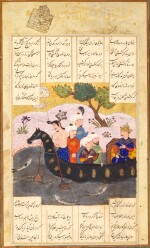
An illustrated and illuminated leaf from a manuscript of Nizami's Kheradnameh: Alexander on his voyage to India, Persia, Shiraz, Timurid, 15th century
Auction Closed
October 27, 03:41 PM GMT
Estimate
4,000 - 6,000 GBP
Lot Details
Description
ink and gouache heightened with gold and silver on paper, 10 lines to the page above and below the painting, written in black nasta'liq script, arranged in four columns, laid down on an album page, the upper buff border inscribed in gold script with the name of the Safavid ruler ''Shah Sultan Husayn'' and bearing his seal impression dated 1125 AH/1713-14 AD, the margins with gilt decoration comprising birds, animals and demon masks within cusped cartouches amidst scrolling vegetation, the reverse laid down on later card, with a calligraphic panel comprising 15 lines of text partially visible
Painting: 10.5 by 10.8cm; text panel: 17.9 by 10.9cm; leaf: 34.2 by 21.9cm.
In gold thuluth in the upper margin: Shah Sultan Husayn, alongside a seal impression giving the name of Sultan Husayn Safavi (r.1694-1722), and the date 1125 AH/1713 AD. The complete parent manuscript of the Kheradnameh from which this leaf originates was likely once in the royal library of the Safavid Sultan Husayn in the first half of the seventeenth century.
You May Also Like


