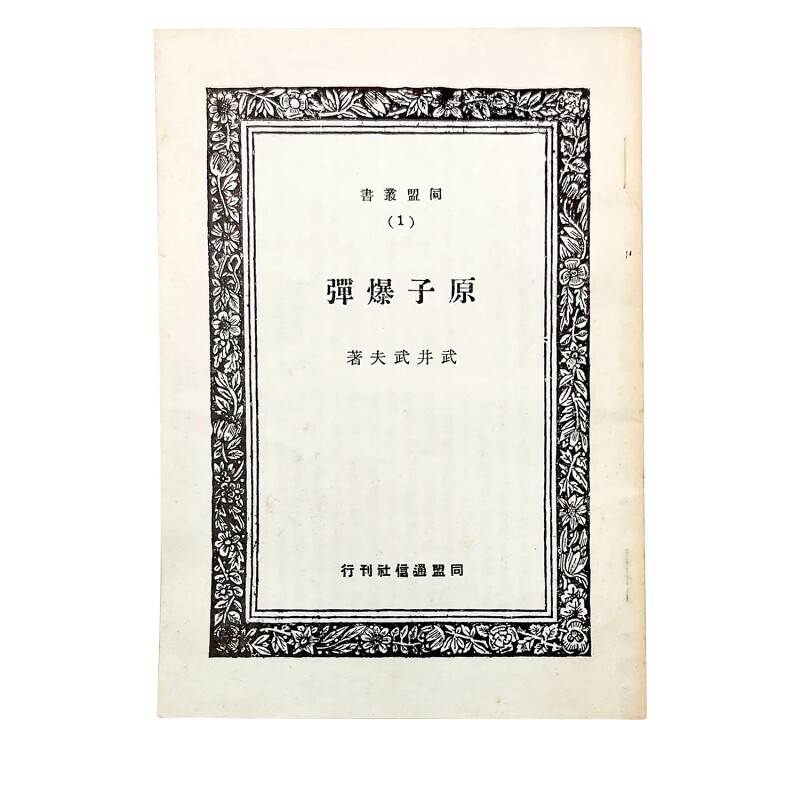


Takei Takeo
Genshi Bakudan [the Atomic Bomb] First Edition
Dōmei Tsūshinsha
1945
Complimentary Shipping
Price:
International shipping available
Customs duties and taxes may apply.
Ships from: Maryland, United States
Taxes not included
VAT and other taxes are not reflected in the listed pricing. Read more
Authenticity guaranteed
We guarantee the authenticity of this item.
Details

Description
First edition of the first book written for the Japanese public on the atomic bombs, printed a little more than a month after the events at Hiroshima and Nagasaki, and issued days after stringent allied censorship regulations went into effect.
- Takei Takeo (Japanese).
- (Tokyo): Dōmei Tsūshinsha, (September 20, 1945).
- 32 pages.
- Text in Japanese.
- Original printed self-wrappers.
The history of the documentation of the atomic bomb sites in the months after the destruction of Hiroshima and Nagasaki is one of censorship. Shortly after the surrender of Japan, comprehensive censorship policies were implemented by Occupational authorities: "On September 18th, 1945, just over a month after Japan surrendered, the U.S. government imposed a strict code of censorship [...] The edict read, in part: 'nothing shall be printed which might, directly or by inference, disturb public tranquility'" (Levy 30-32). Soon after, in October 1945, a more specific ban on photographing the atomic bomb sites was announced (Jenkins 114). These dual policies — combining to produce a "total blackout" according to Walter Cronkite — served to "keep the United States and the rest of the world ignorant of the horrors of nuclear war" (foreword to Weller, ix).
In such a context, this publication is especially interesting. Carrying a printing date of September 15th, 1945 and a date of issue of September 20th, Takeo's pamphlet would appear to have been circulated just after these censorship regulations went into effect. However, according to the rear imprint, it was printed in an edition of 200,000 and its rarity both on the market and in institutional holdings (OCLC locates just 2 in Japan, and 2 more in the US) would strongly suggest that it was in fact suppressed.
The text contains a summary of the events in Hiroshima and Nagasaki (gathered mainly from news reports), an explanation of the mechanics and science of an atomic explosion, a description of radiation and its effects, an account of the development of the bomb, a section on the politics and ethics of the weapon, a consideration of the future of atomic science (including an extended section on the potential of nuclear power), as well as an overview of US newspaper coverage of the bombings (much of it quoted directly). Published by the official news agency of the empire as the first of a six volume series describing and justifying Japan's surrender, Takeo directly addresses a nervous and bewildered Japanese public: "I will not discuss whether the atomic bomb was inhumane or not [... ] Instead, I would like to explain the principle of the atomic bomb itself, what destructive powers it possesses, and how it was planned and constructed, in order to understand why the highest leadership of the Imperial Government came to make such a crucial decision [i.e. surrender at Potsdam]."
A rare document from one of the defining events of the 20th century, told from the Japanese perspective just as such voices were officially being silenced. Important and worthy of further study.
Condition Report
 Very Good
Light foxing and edgewear.
Product is used.
Dimensions
Feature(s)
Language
Subject
Conditions of Business
Please note that the cancellation right for EU/UK purchasers applies to this item. Please read Condition 19 of the Buy Now Marketplace Conditions of Business for buyers for more information. Read more here.