
John Linnell, R.A.
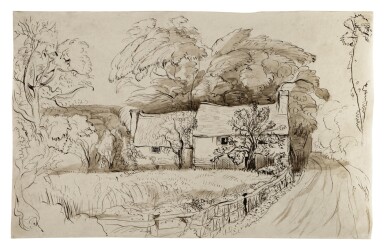
A Farmhouse at Shoreham
Auction Closed
February 4, 06:26 PM GMT
Estimate
12,000 - 18,000 USD
Lot Details
Description
John Linnell, R.A.
(London 1792 - 1882 Redhill, Surrey)
A Farmhouse at Shoreham
Pen and brown ink with brown wash over pencil
202 by 320 mm; 7⅞ by 12⅝ in.
By descent within the artist's family until,
sale, Redhill, Redstone Wood, 17-18 December 1917;
John, 1st Baron Clwyd (1863-1955),
with P. & D. Colnaghi & Co. Ltd, London, Old Master Drawings, 1954, no. 78 (as Samuel Palmer);
Sir John Witt (1907-1982);
with Lowell Libson Ltd, London by 2002,
where acquired by Diane A. Nixon.
London, Courtauld Institute of Art, The John Witt Collection: Part II, 1963, no. 72 (as Samuel Palmer);
New York, The Morgan Library & Museum and Washington, National Gallery of Art, Private Treasures: Four Centuries of European Master Drawings, 2007, no. 79 (entry by Judith Brodie)
J. Sellers, Samuel Palmer, London 1974, pp. 61 & 66, fig. 61 (as Samuel Palmer);
R. Lister, Catalogue Raisonné of the Works of Samul Palmer, Cambridge 1988, no. 109 (as Samuel Palmer or John Linnell)
This drawing is a rare and important example of John Linnell working at Shoreham, the village in Kent that he visited on several occasions in the late 1820s and early 1830s in order to stay with his future son-in-law, Samuel Palmer.1
The two painters had first met in 1822 and, given their age gap (Linnell was thirty and already a successful painter, while Palmer was just seventeen) Linnell soon assumed the role of mentor. He encouraged Palmer to draw directly from nature, to study the art of the early Renaissance and, in 1824, he introduced him to William Blake (1757-1827), an encounter that was to prove crucial for Palmer’s development, both spiritual and artistic.
It was Palmer who first 'discovered' Shoreham, which lies just under twenty miles to the south-east of London, and - enchanted by its bucolic atmosphere - he was to live there from 1826 throughout much of the next decade. The village became a kind of mecca for his close circle of friends who referred to themselves as the ‘Ancients’ – each united by an interest in medieval art, the assertion that ancient man was superior to modern and an idolization of Blake. Linnell was not officially part of this group but with his strong connection to their hero, whom he had known well since 1818, he was certainly well received whenever he visited.
Linnell too enjoyed his time at Shoreham, writing to Palmer in 1828, for example, that ‘I have found so much benefit from my short visit to your valley and the very agreeable way in which we spent the time, that I shall soon be under the necessity of seeing you again very soon at Shoreham. I Dream [sic] of being there every night almost and when I wake it is some time before I recollect that I am at Bayswater… for though I have been at many places on visits I never was anywhere so much at liberty'.2
During Linnell's visits to Shoreham he and Palmer often sketched together and at times both artists made drawings that were stylistically very similar. Indeed, up until the 1980s, the present drawing - with its bold, calligraphic line and sense of intensity - was considered to be by Palmer. Since then, however, attention has shifted to Linnell, with particular comparisons made between the present sheet and Linnell’s pen and ink drawings: Under-river (Private Collection) and The Weald of Kent (Fitzwilliam Museum, Cambridge). Linnell signed both those works with his monogram and the latter is dated 1833.3
1.Samuel Palmer married John Linnell’s daughter, Hannah, in 1837
2.D. Linnell, Blake, Palmer, Linnell and Co. The Life of John Linnell, Sussex 1994, p. 118
3.See K. Crouan, John Linnell, A Centennial Exhibition, New Haven 1983, pp. 23-24, nos. 63 & 64

