
Sold by the Art Institute of Chicago
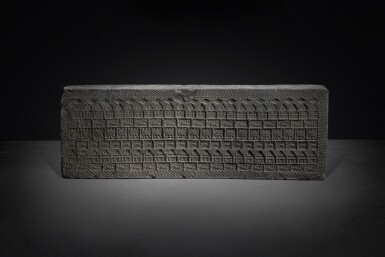
An impressed gray pottery tomb tile, Western Han dynasty
No reserve
Lot closes
March 31, 03:03 PM GMT
Estimate
5,000 - 7,000 USD
Current Bid
200 USD
4 Bids
No reserve
We may charge or debit your saved payment method subject to the terms set out in our Conditions of Business for Buyers.
Read more.Lot Details
Description
Length 54½ in., 138.5 cm; Height 19⅛ in., 48.5 cm; Depth 5½ in., 14 cm
Yamanaka & Company.
Collection of Kate Sturges Buckingham (1858-1937).
Gifted to the Art Institute of Chicago, Chicago, in memory of her sister Lucy Maud Buckingham (1870-1920) in February 1925 (accession no. 1925.107.096).
Wanda Odell, 'Chinese Tomb Tiles', Bulletin of the Art Institute of Chicago, vol. 36, no. 4, 1942, p. 55, fig. 5.
Pamela B. Vandiver, 'Han Dynasty Hollow Mortuary Bricks from Northern China in the Collection of Art Institute of Chicago, Part II: Technological Study', figs 4b and k.
The present tomb tile belongs to a group, often referred to as the Zhengzhou style, characterized by densely patterned surfaces created through repeated mold impressions. Such tiles were produced using carved wooden stamps pressed into damp clay prior to firing, a technique that allowed craftsmen to replicate complex decorative fields with remarkable precision.
The most prominent decorative elements are the masks (pushou), fearsome zoomorphic faces derived from bronze door knockers and handles that frequently appear in Han funerary contexts. Associated with thresholds and gateways, these masks function symbolically as guardians, protecting the tomb and marking the boundary between the worlds of the living and the dead. Accompanying the masks are the tiered watchtowers (que), architectural forms frequently associated with gateways and transitional spaces in Han funerary imagery. In tomb contexts, watchtowers are thought to symbolize key points along the soul’s journey after death, marking passages between the earthly realm and the celestial landscape often associated with Mount Kunlun, the mythical abode of immortals. When combined with protective motifs such as masks and scenes of pursuit or hunting, these towers may also evoke guardianship and vigilance, reinforcing the role of the tomb as a protected threshold between worlds.
Compare a related example with 'mask and chariot' motifs, formerly in the Collection of Ralph (1855–1926) and Fanny Tewksbury (1867–1949) King, now preserved in the Cleveland Museum of Art, illustrated on the museum's website (accession no. 1915.73).
You May Also Like


