
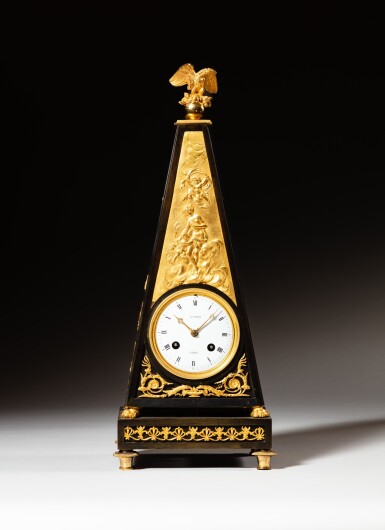
A Louis XVI gilt and patinated bronze pyramid clock, circa 1780, the dial signed Lepaute
No reserve
Estimate
5,000 - 8,000 EUR
Lot Details
Description
the restored enamel dial signed Le Paute, A Paris, bell striking movement with silk suspension and outside count wheel, the case surmounted by an eagle and set with a plaque depicting Venus and Cupid, on an integral stand
Haut. 56 cm, larg. 23 cm ; height. 22 in, width. 9 in
Related literature
Tardy, La pendule Française, 2e partie, Paris, 1975, p.265.
Pierre-Basile Lepaute (1750–1843), known as Sully-Lepaute, Horloger de l'Empereur and Horloger du roi, was one of the leading watchmakers of the late 18th and early 19th centuries. Born into a dynasty of clockmakers, he trained in the family workshop before joining forces with his uncle and cousin, then founding a new workshop with his nephew, which became the official supplier to the Emperor. The latter took a table clock by this clockmaker with him when he went into exile on the island of Saint Helena, stopped at the hour of Napoleon I's death.
Although he is best known for his Empire models, Pierre-Basile Lepaute made his first clocks at the end of the 18th century in a neoclassical style, as in the case of our obelisk clock. This shape is characteristic of the end of Louis XVI's reign, often featuring bas-reliefs depicting Cupid holding the torch of Hymen, supported by the three Graces (see Replica Shoes 's Paris sale, 23 September 2025, lot 103). Our clock is decorated with a variation featuring Venus and Cupid in clouds. Another similar obelisk clock with the same bas-relief, signed Thiery in Paris, is illustrated in Tardy, La pendule Française, Part 2, Paris, 1975, p. 265, no. 1.